Pinkerton's Bestiary: The Vorvolakos
The Vorvolakos, the Primary Species of Vampire

When trying to properly categorize all the various species of legitimate vampires, it’s best to think of the Vorvolakos as a sort of hub or central starting point. There are two central starting points, or two hubs if you will. The second is the Vrykolakas, but I will address them in another log. For the present, I’ve started with a chart to demonstrate what I mean.
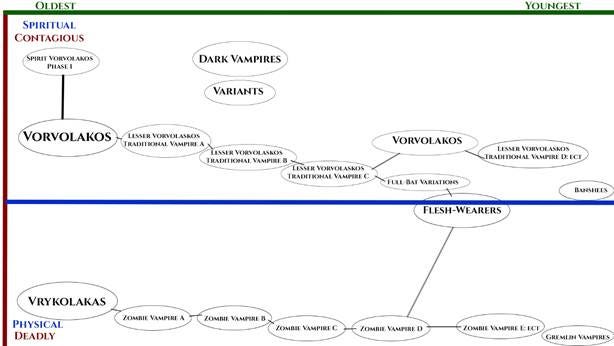
As you can see, the strains of vampirism stem from two branches, and in this log, we are talking about the first. The Vorvolakos are the more sentient of the strains. Unlike the Vrykolakas strain, which aside from advanced physical capabilities and endurance—and in the case of the Vrykolakas themselves, a supernatural talent that only affects other vampires—the Vorvolakos have taken on a human form and have a variety of supernatural talents.
But what should be made plain from the chart is that as the Vorvolakos strain weakens over time, it becomes more and more physical and less affected by religious defenses. The various traditional vampires are all essentially Vorvolakos, but they retain fewer and fewer of the spiritual abilities, manipulating elements, turning into fog, mental influence, and so on. From what we can tell, this tends to happen in cycles, the later variations becoming so limited that the most they can manage is leaping from a tall building without breaking their necks. They can swoon when they bleed out, and in some cases one no longer needs to worry about only attacking the head or heart of both to dispatch them. They can be killed like any normal man. In effect, they’re basically super soldiers that require blood to survive, but these soldiers don’t even have the advantage of the vampiric speed.
When the strain weakens to this point, what eventually happens is the next generation of victims will fall into two variations (I remind you that this is one of many theories, and this is what I was referencing when I mentioned mutations in the previous log.): The first becomes a full-bat Vampire, a vampire with exceptional speed and strength but unable to take a human form. The second returns to the original variation of the strain, a full Vorvolakos. It’s almost as if the virus must expunge the taint of physicality before it can return to its original state. This seems to be the natural Vorvolakos cycle, which brings us to the next obvious question: how does the cycle start?
Answering this question also requires me to address how the Vorvolakos eventually manifest their abilities over time. And time is the key matter. It’s entirely possible for a full Vorvolakos to never manifest all of his or her abilities because the vampire believes it suffers from a later generation of the curse. So, in order to discuss vampiric origins, we must also discuss the eleven stages of Vorvolakos development.
Phase 1 (or, if you prefer, stage one.)
While the origin of the vampire is unknown, most agree that vampirism originated in the Antediluvian Age. They are supposedly a part of the chimeric experimentation taking place during that time; only the men of that age were also introducing the demonic to their experiments. The end result was the vampires and the shapeshifting class. Now, somehow the rituals used to create these creatures were either remade or discovered, and the men of the post-flood age recreated the creatures during their time. Therefore, whenever a plague of vampirism breaks out seemingly from nowhere, the host vampire almost always has its origin in a ceremony, and this creature is usually fully demonic; the man is gone, indwelt by a wholly different entity.
This is why vampirism always seems to pop up and disappear in brief spats. A cult arises, creates the vampire, and the people in that area are forced to eradicate the plague. However, one or more of the vampires often survive the extermination and flee the area, then the generational process I’ve described takes place. The small group of survivors become migratory, feed on victims—often without killing them, for that would draw too much attention—then that person turns, repeats the process, and so on. In the host vampire’s case, that vampire is usually tied to the area or has some agreement or reason to follow the cult’s instructions, so it doesn’t begin migrating.
(Note: these cult attempts are rare. The ceremony is very complicated, and most cultists are really hobbyists. But if you spot witchcraft symbols or evidence of ceremonies during an investigation, your job will become not just to eradicate the vampire but the cult as well. Use whatever means necessary to make sure they can’t recreate the incantation.) (Second Note: There is also a ceremony where a living soul can be transformed into a vampire. However, the process doesn’t complete itself until after their deaths. Usually, the most that will happen is that they will develop a saliva that numbs the skin—much like the flesh wearers—they will suffer from an aversion to sunlight—although it will not kill them—and they will come to like blood and hate food—although they will still need food to survive. Prayer repels this curse while the man or woman is still living.)
Once the vampire has been created through means of a ceremony, it appears as a shadow being, usually with red eyes. It enters homes where there is a weakness in the threshold—usually the victim in question is dealing with a particular sin like an addiction or has recently interacted with the demonic. The shadow entity will roam the town feeding on all the victims it can find. Sometimes, these attacks are frequent enough to kill the victim, but not always, and it is a matter of debate whether these individuals will turn if they are bitten during phase one. I have no strong opinion on this question. I suspect that they don’t, since the venom is not physically present at this point.
When it has accumulated enough blood—the time frame can vary—the vampire will animate a body. I don’t know if they need a particular body or not. I know that the cults tend to prepare a body so as to make the process easier and/or faster, and I will say that these cults—as well as the entities themselves—seem to enjoy selecting some low-life who has a bad reputation in the town. It’s important to reiterate that a host vampire is not human. They are fully demonic and must be dealt with accordingly. Any spiritual defense, not just holy water and crucifixes, but prayer and fasting, can and should be used to deal with these things. They do not have a physical form and are subject to all the laws spiritual entities must obey. They are still full-blown demons at this point and should be treated as such.
Phase Two: The demon is basically a walking corpse. They are physically indistinguishable from the Dark Vampires who choose to rot in order to obtain power. If a victim is bitten at this stage, they will turn when they die. People who are bitten are told to be cremated after they pass. In these first two stages, the vampire will be feeding at an accelerated rate because the goal is to reach stage three as fast as possible.
Phase Three: This is where every vampire enters the ranking, both host and turned. In the host’s case, it will continue to feed until the body returns to its state shortly before death and has obtained the basic vampiric powers. In the turned’s case, after approximately three days, they wake with a corrupted body. The basic starting point for these creatures is to have advanced speed and strength, unless they are a later, weaker generation of Vorvolakos, in which case they are only afflicted with marginal strength and the hunger. And this brings us to the subject of the hunger. Of course, every vampire is afflicted with it, but what is this hunger exactly? The short answer is that we don’t know. So far as we can tell, it is a sort of demon, but it might be better to refer to it as a half-demon. Demons possess a low cunning, and the hunger possesses a lower cunning still. What I mean is that no one is sure if the hunger itself is sentient. I prefer to look at the hunger as a sort of demonic download. It latches onto the baser desires and temperament of the victim and begins working that person’s darker qualities toward a single end: to feed. The cravings are both physical and mental, and the more the person indulges this impulse, the more the hunger takes over; that is to say, a new personality emerges, one that is and isn’t the personality of the victim. Victims who fully indulge the hunger become little different than a demon. That’s why we resort to killing them as often as we do; the further down that road the victim travels, the harder it is to bring him or her back. Some would say it’s impossible more often than not. Eventually, the vampire learns to utilize its speed and strength and begins experimenting with its abilities. This brings us to the next phase.
Phase Four: The first new trick the vampire learns is shapeshifting. They transform into bats, rather large bats mind you, wolves, snakes, creatures with a negative connotation. They are still taking a singular form at this point. I’m not talking about vampires who can transform into moths, or rats, or various types of creatures that can swarm. They use these basic forms for stealth. They do not use them to enter thresholds, although they can break a window in this form and bid a hypnotized victim to come to them.
(Note: I should speak briefly about thresholds. A vampire cannot enter a home or church unbidden. However, they can enter anything considered a public place. The more people enter in and out of a building, the weaker the threshold. And understand that what constitutes a home isn’t just a house. Say, for example, two young lovers are meeting in a cave for a romantic rendezvous. If the rendezvous is physical in nature and these encounters are habitual, the lovers, without their knowledge, can create a home. I mention this because I recently had a pair of hunters use this to their advantage. They were able to utilize a cave as protection against a shifter because some college students were meeting there. Something to bear in mind should you run into trouble.)
Phase Five: This is when the truly dangerous magical abilities come into play. Bear in mind that most of the lesser Vorvolakos will never reach this phase—a few, but not many. The vampire learns that he or she can place his victims under a trance. And not only that, they learn that they can use their bite as a curse mark, a way to track their victims. I should point out that while most of the vampire’s abilities have been understated, the hypnotic capabilities of the vampire have been exaggerated over time. I should be careful on this point. The cliché of the vampire compelling someone to come toward them does happen, but there are rules. The key concept to remember is links. Now, the simplest way this can happen is prolonged eye contact. There is some limited truth to the saying that the eyes are the windows into the soul. It’s unwise to look into the eyes of a vampire as a rule, but honestly, most of them don’t even know how the talent works, so they won’t even know they can grab you if you do make such a mistake. I’ve heard of one case where a woman tried to entice a man while still on her deathbed, but this is a very rare thing, and it suggests the woman has a hint of magical talent that was unrecognized in her prior life as a mortal. Most of the time, a vampire doesn’t learn the eye trick until it reaches one of the later stages, but we link this talent with phase five because it’s at this point the vampire begins to experiment with the ability. The vampire can also read the minds of its victims. In the beginning, this is more embarrassing than dangerous, but as time goes on, they also learn to plant ideas and images into the brain. It’s important to note that from here on out, these powers will grow as the stages progress. Alongside the vampire’s fledgling attempts at hypnosis, mind reading, and tracking, the vampire will experience upgrades in speed and strength. These two talents in particular will grow exponentially as the vampire moves up the phases. Lastly, the vampire will be able to transform into a wider variety of creatures, will make its first attempt at shapeshifting into a human-bat hybrid, and will even be able to transform into mist.
Phase six: This stage is marked by an increase in all the prior talents mentioned. The speed and strength are faster, the mental capabilities grow stronger, their hybrid variation takes a more organized, final form, and they can produce mist, not just turn into it. They can also now control certain beasts of the earth, wolves and such. But the chief hallmark of this talent is the ability to transform into swarms. By this we mean rats, moths, beetles, even swirling bits of dust. Essentially, the vampire realizes it can break itself up and remain sentient once it figures out the mist trick and begins to wonder what else it can do. These methods are usually escape attempts. And I don’t mean to say that transforming into mist naturally leads to the other. The experimentation gap is exponential between stages five and six. And there are other things to consider. During this phase, the vampire experiments with leaving its mind in one of the creatures while controlling the others, then it moves to turning the entire swarm into a sort of hive consciousness; that is to say, the whole nasty thing has to be destroyed to kill the vampire. One cannot simply find King Rat and crush it. The whole wretched thing must be eliminated; otherwise, the vampire will regenerate. Thankfully, the vampires are weak to fire when they do this, so this isn’t a trick they’ll resort to often. The creature becomes disoriented if the swarm is broken up, and it takes it some time to choose where it wishes to reform. It’s a risky play. Technically, all you have to do is capture one or two of the creatures in question and keep an eye on them. Then the creature runs the risk of manifesting right in front of you, and you can dispatch it while it’s trying to reform and repair itself, since it cannot bring the creatures it chose to abandon with him. A vampire will really only resort to this when it’s cornered. (Note: Another thing a vampire sometimes does when it realizes it can break itself up is that it will take out its heart and hide it. This is similar to a trick the wizard will sometimes pull. A wizard will transfer his life force, or a part of his silver cord, to an object. We affectionately call these objects soul trinkets. The advantage is you can’t kill the man without destroying the trinkets, but in the vampire’s case, he runs a risk of some kid digging up his heart and feeding it to a dog. And yes. According to a friend of mine, that happened.)
Phase Seven: General increase in all prior talents and the manifestation of a vampire’s unique abilities. This gets a little complicated, but I’ll try to keep it simple. The easiest way to explain this is by example. If a vampire tends to resort to sex to lure its prey, its various talents will begin to lean toward that end. The vampire will be able to tempt a man beyond what is natural. Or let’s say the vampire leans into fear. His mental talents will inject images of dread in his target’s mind. When this happens, a sort of aura develops around the vampire. It begins to produce a vibe that explains what the vampire is all about. Images might pour into a person’s mind unbidden, images that explain what the creature is. Their talents will become more unique, and the vampire will seem more alien and less human. They start to become otherworldly. Normally, a vampire who is able to reach this stage will be nearing a thousand years old, or at least north of five hundred. If they’ve broken a thousand years of age, their hair will change color, usually to an oversaturated hue of whatever their color was in life; red becomes crimson, for example. I know of one vampire whose hair turned green. I’ve been told this can happen, but it’s unusual, even by a vampire’s standards. The most dangerous aspect of a vampire during this stage is that they create plagues within a certain radius. It’s unclear how they do this. The plague can be defended against by all normal means, so if the region is clean, there’s little to worry about, but the fact remains they can make people ill if they choose. I don’t believe they are able to infect people directly. I think they can infect the lower beasts in the area, rodents and such. If the town doesn’t have good sanitation, this can become a problem. Otherwise, a vampire might try this, and no one would notice. Phase Seven is very rare; the others are rarer still. This stage is for the true heavy hitters.
Phase Eight: General increase in all prior talents, and there is one chief distinction. They can now control the weather. They can create storms, and they no longer just produce fog in a localized area; they can fog up an entire bay or city.
Phase Nine: General increase in all prior talents, with the addition of elemental control. This means they can weaponize fire, lightning, water. They can shoot these elements at you from their fingertips or cause flames to leap from a hearth and burn you alive. They can cause earthquakes. The vampires here require certain defenses not common to hunters. You’ll need to ask the Order for assistance. There are certain symbols we use as a defense against magical attacks. If you encounter such a vampire, you’ll need them. I should point out that not even the Vorvolakos Covenant has many, if any, members who have such abilities. These types of vampires are usually very isolated. They have no need for committees. The other talent they possess at this phase is control of shapeshifters. Now, the vampire no longer controls wolves and basic beasts, but even beasts of the magic variety. Should you find yourself in the strange situation where a werewolf is in your employ, do not under any circumstances let that werewolf near the vampire, even if they can control their transformation. This vampire has the ability to override their control and use the cursed form against you. The same goes for any shapeshifter, potion drinker, or wizard who wants to try their luck. I have had no dealings with fairy beings, but I suspect this vampire could control them as well. There are different types of magic in the world, and the vampire’s magic is internal, and it overrides shapeshifting magic. Arguably, they are the first shapeshifters, given their bat form, so this isn’t unexpected. Once they reach this stage, they have total control of the shapeshifting realm.
Phase Ten: General increase in all prior abilities and one chief new talent. They can create a long-lasting cloud cover that enables them to walk in the day. This cloud cover can last as long as they choose. Normally, if a vampire can walk around during the day, it will only be around dawn or dusk—unless they’re a Variant—but they will be human in terms of their power. This is not so with vampires who’ve reached Phase Ten. They can move in the day with their full arsenal of abilities. To my knowledge, while such vampires have existed in the past, there is no known vampire alive who is capable of this. Should you run into such a creature, call the Order immediately, but don’t be surprised if they refuse to believe you.
Phase Eleven: This last phase is only a legend. It involves not just being able to walk around during the day but the total control of light itself. I don’t know what this means exactly. I don’t know if they shoot lasers or make portals, but whatever they do, they are said to be powerful to the maximum degree. It is said that a vampire who reaches this stage is given the choice to die, and should they choose to die, they are allowed one miracle—with limitations, I’m sure—before they leave. There is no record of such a vampire, only records that insist this level exists.
These eleven phases are the most complete explanation of the Vorvolakos I can manage. I’m sure I’ve forgotten a few things, abbreviating thousands of years of text and all, but this gives you a good idea of what you’re up against. The advantage to fighting a Vorvolakos is that all spiritual defenses work—garlic, holy water, crucifixes, prayer, especially prayer, everything. That fact alone mitigates most of this. Most of the time you won’t be dealing with a Vorvolakos but a weaker generation of the strain. The Vorvolakos are usually found mixing around in upper political circles, not harassing some poor town in the Midwest. They’re usually very old. And it’s a matter of some debate how many feedings they can get away with before the weaker generations start to manifest. On top of that, most vampires die within the first year of their turning. I’d say about ninety percent of the vampires you come across you’ll be killing before the end of their natural lifespans. Vampirism is in fact an early death. Enjoying any form of prolonged life, let alone immortality, isn’t quite as rare as winning the lottery in their case, but the odds are against them. This is why vampires aren’t more common. Sure, they infect a lot of people, but the infection is short-lived. If we do our jobs well, we can get to these creatures before too many of their loved ones know their relative has turned—always check the relatives first—and the few who do know of the situation will usually take that secret to their own graves. It’s also important to note that the Vorvolakos have a culture that strongly encourages them to prevent turnings. They are wildly concerned about their resources. The only issue really comes with knowing which generation you’re dealing with because in nearly all cases you’ll be dealing with a very young vampire. The only reason we know of the other generations is because covens occasionally rise up in inner cities and in small towns. But even those often wipe each other out for territory. The point is if you do run into a Vorvolakos and can confirm that it is such a being, you’ll be dealing with a rare case indeed.
In terms of the gradual increases in speed and strength, I would suggest not stressing out much about this matter. The weakest vampire is still faster and stronger than you anyway.
I shall discuss the Vrykolokas in the next log.
Read Pinkerton’s Bestiary Log 1
Read Pinkerton’s Bestiary Log 2
(The first three entries of Pinkerton’s Bestiary will be available to all readers. Beginning with later logs, this series will continue exclusively for paid subscribers, where it expands into deeper worldbuilding, monster descriptions, case histories, and ongoing narrative threads.)
“If you’d like to read more of my work, The Familiar (a dark urban fantasy) is out on Amazon and garypaulvarner.org. Gerome is a Familiar who gave his blood to a vampire. But now the vampire wants his wife. This book is the first of a larger series called Annals of S.O.L.M. If you’d like to support my work, The Familiar will be found on Amazon, Apple Books, Barnes & Noble, and more. I hope you enjoyed this final free entry of Pinkerton’s Bestiary.”