
The Starward Exiles The Chosen Battleground (Serial Novel)

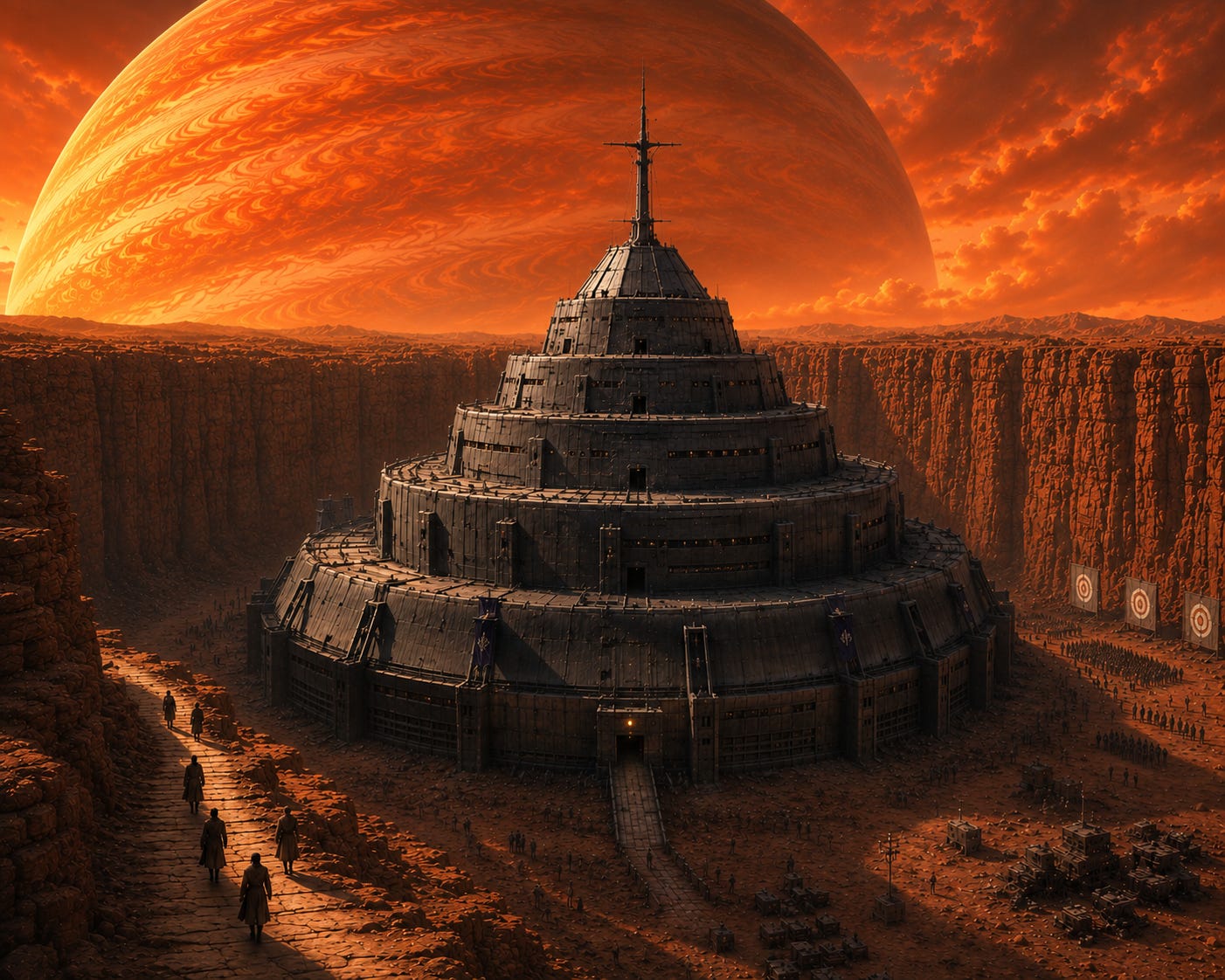
Fort Zoas was massive. The town we’d just visited had looked like a primitive encampment for a usually technologically advanced race. Here, the full power of the Delvians was on display. The architecture was still fundamentally the same. The homes inside the town had looked like a large lid with a wooden pyramid on top, but the fort looked more like a spiral minaret than anything else, although the structure was wider than it was tall. It had an enormous, wide section as the first story, a slightly narrower section on top of that, and so on until it reached six stories. The seventh story was a pyramid with a large bar protruding from the top that looked something like an antenna. The whole thing was made of a strange grey metal that reminded me of polished steel but was coarse.
We approached the fort from another sandstone path. I became very dejected when I noticed the foliage thinning as we went, realizing that we were about to endure even more barren terrain. I don’t know what it is about the Droguldai light, but it seems only certain kinds of plant life can grow in it, and even that can only survive in dense pockets. Sure enough, the land around us soon became indistinguishable from a desert, although the temperature was mild. We then saw the top of a canyon, but we didn’t see the fort until we were standing at its edge.
The fort was tall, but not as tall as the canyon itself. In fact, even the antenna was several hundred feet below the edge, and I suspected there was some sort of purpose for this, but I couldn’t say what it was.
The sandstone path led us down a winding trail, and I could soon make out countless little bodies at the base of the canyon. There were various groupings of men, some in disorganized masses, others in formal lines. The lines were firing laser beams at large targets painted on the canyon’s eastern wall. As we got closer to the base, I saw that the masses were handling swords and other types of medieval weaponry. I looked at Mark, wanting to ask about this bizarre site, but thought better of it. On Earth, the humans had focused on ways to work around the Nordics’ shields. This had led to a variety of technology focused on disrupting the various waves making up the shields, and in time we’d developed shields as well, but no race, so far as I was aware, had resorted to close-range weaponry. I couldn’t make out the advantage. Why were the Delvians, who were said to be one of the Nordics’ greatest adversaries, using such tactics?
As we walked, I continued watching the soldiers train. I realized that it was only the Delvians who were using the medieval weapons, and they were all wearing ornate armor similar to Mark’s, but they were different colors. There were no uniforms, no common color scheme; everyone’s look was distinct. I supposed that a group of people who looked so similar to each other would have no use for uniforms nor would they have a desire to wear one.
The group shooting the lasers was the Baavi. They were referred to as a blond variant, which is to say that they looked and dressed a great deal like the Nordics, only they were the average height of a man. It made sense that they would use weaponry similar to the Nordics, but why were they at this fort? The Baavi were among the first to break away from the confederation. They’d worked with the Droguldai when the Droguldai were still siding with the Nordics. Had the Baavi decided to return to the confederation? They must have, but I was curious why I hadn’t heard anything about it before leaving Earth. Perhaps their decision was a recent one, but it would have to be very recent.
My surprise grew further when I saw a small group of Cetians training among the Baavi as well. They looked to be Mediterranean in origin. They were indistinguishable from humans, save for the fact that they bled green blood. This led me to suspect that a number of planets were now wishing to return to the confederation. They must’ve been reminded of the Nordics’ harsh treatment.
As we passed, a number of the soldiers ceased their training and began staring at me. I suppose my habit was drawing attention, even among the Delvians, despite their own odd attire.
We crossed the flat, sandy base and entered the building. I was surrounded by chrome walls, glowing screens, and various flashing buttons that I didn’t understand. I lowered my head and kept it down the rest of the way. I was somewhat afraid someone was going to stop us and ask about my attire if I mistakenly made eye contact. I could hear men laughing, and there were various noises that suggested some of the soldiers were playing games in a sort of rec room, but, no matter what I heard, I refused to lift my eyes.
Mark led us up several flights of stairs until we entered a large room, and I once again dared to lift my head. This time I was surrounded by windows overlooking the western side of the canyon. Below the windows was a control panel that filled three sides of the room. It was covered with more screens and buttons. In the center of the room was a long, oval, metal table, covered with maps and papers. Hovering over the tables were five men. The man on the right-hand side of the table, a Delvian, lifted his head and smiled. He rushed toward Mark and wrapped him in a warm hug, slapping his back several times.
“So, the green gal didn’t eat you!” he cried. “Glad you made it safe.”
“It’s good to see you, Kordus,” Mark said. “I have our first shipment of meltar. It’s in the southern field, and more should be coming.”
“Good, cause we’re about out,” Kordus said. “The experiments alone were about to kill us.”
Mark smiled. “It’s going to work, isn’t it? I knew it would. And you wouldn’t keep using the fuel if it was going to fail.”
Kordus returned Mark’s grin with a wolfish expression, showing all his teeth. “They’re not going to know what hit them. And once they’re on the ground, they’re ours.”
“No. They’re not,” another man said. He looked up, and I almost gasped. The man’s appearance was shocking. His skin was ink black, save for his glowing green eyes. They were emerald around the whites, and the irises were a shade of darker green that I could make out but somehow still seemed to glow. “I just told you. If your hero here can bait them like he plans, they’ll send the Negumaks.”
“They’re squids,” Kordus said. “What can they really do?
“Have you seen them on the field?” the man asked.
“We’ve fought a few,” Kordus said. “They’re tough, but not invincible.”
“In a group?” the man clarified.
“No,” Kordus admitted.
The man snapped his head toward another figure standing at the table, and I saw with some shock that he was a human with ash-grey hair. “Williamson, what did you call those ancient men? The Vikings?”
“Berserkers,” Williamson said without looking up from his map.
The man turned back to Kordus. “They’re berserkers. They slam into your line and break it.”
Kordus rolled his eyes. “You humans and Montocs fight as clusters. It enables you to become swarmed. We have shields and line formations. If they get close enough together to break our line, they’ll trip on their own tentacles.” Kordus shook his head and looked back at Mark. “You better introduce your group before we begin arguing again.”
Mark nodded and pointed to each member of the group as he introduced them. “This is Jill, Helen, Cynthia, Heath, and our monk, Nicholas.”
Kordus gave each of us a brief smile and nod, then pointed at the table and said, “My vocal friend is called Iros. He’s a Montoc, who were a neutral party until recently. The human is General Williamson. We’ve worked together for a long time. The Baavi is Commander Jorgon, and Cetian is called Commander Halmont.”
None of the men, save Iros, regarded us as Krodus spoke.
“So, no Droguldai representative?” Heath asked.
“Just Mark,” Kordus said. “He’s been our ambassador for this affair. The Droguldai won’t be revealing themselves until the battle,” Kordus said. “They’re our surprise.”
“I’m not sure we need the monk yet,” Williamson said, continuing to study his maps. “I don’t mind him here for now, but I’d prefer he not participate in the war councils going forward. Best he focus on his work.”
“But we are interested in your supply strategy,” Commander Jorgon, the Baavi, said.
“I’m not letting go of the Negumak point,” Iros said. “I don’t think any of you are taking them seriously.”
“I’ve seen them on the field,” Halmont said. “They charge in a horde. I suspect the Delvian line might be the best counter for them, Iros.”
“We’ll talk about it later,” Williamson said. “I think discussing the supply strategy is the best use of our time since we have the head pilot here.”
“Do you mean Heath?” Jill asked.
“I do,” Williamson said.
“Me?” Heath asked. “Why?”
“Isn’t it obvious?” Jill asked. “Madulluel wants a war hero, and you already have a reputation as a smuggler. Running supplies for the war effort is a natural fit.”
“I’m not sure it’ll be enough,” Helen said.
“I’m sure Madulluel will embellish if it isn’t,” Mark said. “Jill’s right. Before the battle, Heath, you’ll be running supplies with me to various planets.”
“Though I’m not sure I understand your routes,” Williamson said.
“Right,” Jorgon agreed. “I understand raiding supplies from mining and farming planets, but why are you dropping supplies off at the breeding planets? It would make more sense to run the supplies straight to the fort.”
“Yes. And the weapons,” Halmont added. “Those breeders are as likely to turn on us as help us. I understand the slaves. They’re worked till they drop, but those breeders have as easy a life as you can imagine: eat and breed all day.”
I looked over at Heath and the others. All their faces were pale. Heath, Cynthia, and Jill were working very hard to suppress their rage. Mark’s face was a mask of neutrality, a small bemused grin on his lips. Helen was trembling.”
“You ever had a baby pulled from your arms?” Helen whispered through clenched teeth.
For once, everyone looked up from their maps at the same time. They all glared at Helen. I understood why. I’d met such men during my time in the army, men who prioritize utility, strategy, and doing what needs to be done. It’s hard to be cold when the vision of a baby being torn from a mother’s arms is floating in the room. Such a vision tends to remove the academic distance. For a moment, those men hated Helen.
“Helen, this isn’t the time,” Heath said.
“No. She raises an excellent point,” Mark said, still smiling. “I can’t speak for the Cetians, Halmont, but Delvians and Humans care deeply for their children, and they remember.”
“Our people care for our own! How dare you!” Halmont shouted.
“Then you should understand exactly why the breeders will revolt. Cetians are on the breeding planets too, more so since your people abandoned the confederation,” Mark said.
“You impudent—” Halmont began.
“I have no doubt that they will revolt,” Williamson said. “But why are we dropping off supplies? Those planets are heavily guarded. It’s going to be more difficult to sneak in and out of them. From here, it looks like you’re increasing our chances of getting caught.”
“That’s why I’ve hired Heath,” Mark said. “Those brothels he’s been known for attacking aren’t just guarded; they’re hubs for the soldiers. If he can sneak in and out of the planets where they’re located, then infiltrating the breeding planets will be no problem.”
“Even assuming that’s so, why?” Williamson insisted.
“The breeders are on an open planet,” Kordus said. “The slaves are trapped in heavily guarded camps. Their revolts are more local and will be easier to put down.”
“If the breeders are on open planets, then why don’t they hide the children you’re so worried about?” Halmont asked.
“A couple reasons,” Kordus said. “Fear of the others in the harems keeps the breeders in check, and the Nordics have trackers in the breeders’ arms. But we can remove the trackers just before they choose to revolt, and if we do that, the Nordics will have to chase their own stock all over a bunch of topography. It drains their resources.”
Williamson groaned. “You’re all missing the point. The supplies. Why hide the supplies?”
“Have you looked at the star charts?” Mark asked.
“No,” Williamson said. “I’ve been prepping for this battle.”
“I understand,” Mark said. “But I’m playing a different game. I’m not just smuggling supplies to this planet. I’m building a . . . railroad.”
“A what?” Iros asked.
“Old Earth tech,” Williamson said mildly. “You’re saying you want an established supply line before this battle even begins?”
“Right,” Mark said.
“Both the battle and the invasion fail if we’re caught prematurely,” Williamson said. “This isn’t the right time.”
“I disagree,” Mark said. “Supply lines take time, and we need to move fast if we want the Nordics to panic and reposition their fleet to where we can anticipate their movements.”
“For Terras to anticipate their movements,” Iros said. “We know where they are.”
“So, you could tell us if the Nordics were amassing an invasion of Earth?” Mark asked.
“There is no such invasion,” Iros said.
“If you’re so sure, then why has information about their locations been so slow?” Mark asked. “Why are the Nordics spending so much time in deep space? I think it’s because they’re amassing in one distant location and plan to punch through the confederation from one direction. Of course, no one can say for sure because we’ve had little word of their movements for the last year. If the Montocs know something we don’t, now would be a good time to tell us.”
Iros sneered. “You know what I think. I think sentiment has gotten the better of you. I think you’re still an Earthling at heart, and you’re contriving strategies around saving the downtrodden. I think you’re going to kill us all.”
“Then why are you here?” Mark asked.
“To stop you,” Iros said.
“Okay,” Kordus said, smiling sheepishly and lifting his hands in a placating gesture. “This is too heated. No one is here to stop anybody. We have to work together if we’re going to win.”
“I agree,” Mark said. “There’s no need to stop me, Iros. If I’m wrong, I’ll be the first to die; then you can take over. Unless, of course, you plan to stand by my side on the field.”
“I’m not so foolish,” Iros said. “I have no interest in bravado.”
“Then you can tell Madulluel all about my sentimentality when she gets here,” Mark said. “Until then, she’s elected me to represent the Droguldai in this matter, so you shall treat me as an equal in this room, and if you refuse, I’ll be compelled to demand my rights by force.”
“We start pulling that card, we’re all finished,” Williamson said. “Mark, until Madulluel arrives, you have an equal place in this council. Iros, show him some respect. Anything else is wasting time.”
Kordus looked at Mark and said, “Why don’t you and your team leave for a few minutes so everyone can calm down?”
Mark nodded and said in a low voice. “I’ll give it a couple hours. I need to return the monk to his church anyway. But Kordus, if the plan isn’t set, I need to know. The pieces are moving.”
Kordus whispered. “It’s set. The Droguldai are funding this whole thing. You don’t need to throw your weight around. You represent Madulluel, and she represents the money.”
“I apologize if I seemed impatient,” Mark said. “It just seems that Iros needs a firm hand.”
“He does,” Kordus agreed. “And if you leave now, I think the message will be sent without any damage.”
“Alright then,” Mark said. “I guess you’ve should’ve spent more time teaching me about diplomacy.”
Kordus smiled. “What is it your planet says? A jack of all trades is a master of none?”
Mark smiled back at him. “That’s right.”
Kordus said, “I need you to survive the field. I can smooth over things here.”
The two men shook hands, and we all left the room.
Mark guided us back to the church. I wish I could say that we all shared a warm goodbye, but at the time, I don’t think any of us realized how long it would be before we saw each other again. Several months went by, and I shall cover them as briefly as I can in the next entry.
May God grant you peace.
Hieromonk Nicholas Petrov.
The Starward Exiles: Entry 1

My name is Nicholas Petrov. I guess you could say that I’m a Russian Orthodox priest, although, I grew up in the United Provinces, so our services are in English. Or they were before I left for the mission field. The truth is that I haven’t been to one of our services in a long time. Some might say this is why I’ve picked up a few supposed heretical vie…
