The Starward Exiles: Entry 1
The Theory of Spectral Time

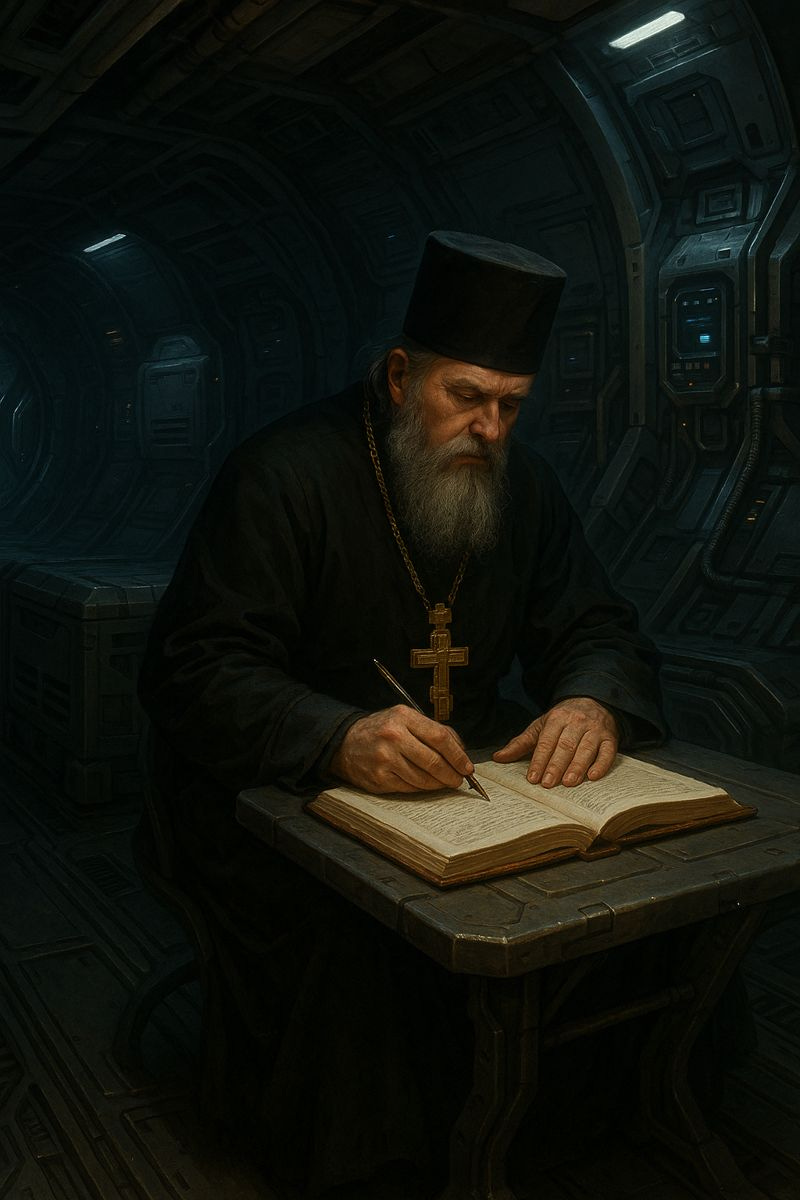
My name is Nicholas Petrov. I guess you could say that I’m a Russian Orthodox priest, although, I grew up in the United Provinces, so our services are in English. Or they were before I left for the mission field. The truth is that I haven’t been to one of our services in a long time. Some might say this is why I’ve picked up a few supposed heretical views over the years. But no matter.
This writing is meant to be a part of a grand experiment, one I barely understand. Science is not my field, and I’ve been told repeatedly by the priests in lab coats that their ways are higher than mine, so I won’t attempt to describe this endeavor in any technical detail. The simplest way to put the matter is that mankind has finally discovered time travel—although he has yet to master it.
It’s a funny thing. I wonder—given the subject of this experiment, I suppose the question is appropriate—if five hundred years ago, man would ever have guessed that he would discover and rule over aliens before he discovered consistent time travel. I imagine they would be quite shocked to learn this was the case. If you’re reading this, I imagine you’re quite shocked as well. Yes. It’s true. Mankind has been both master and slave in the time it has taken to make the most rudimentary discoveries in successful time travel. The trouble isn’t sending things into the past. That is quite doable and has been doable for some time. The trouble is getting the objects back. There is also the pesky matter of traveling into the future.
The basic nature of the problem is that time is essentially the border of our universe. In a sense, light and time are synonymous, so light and time stand as a barrier between the physical and the abstract. Notice that I am talking philosophy, not technicality. There is a distinction for you self-made lawyers out there. But much like with atomic theory some 800 years ago, although the scientist cannot see the atom, he assumes the atom exists, and by assuming its existence, he is able to make predictions. Such is the case with The Theory of Spectral Time. What is The Theory of Spectral Time exactly? Well, it’s best defined with an equation, but I know that will mean little to my potential readers, so I will attempt to explain it as briefly as possible.
The Theory of Spectral Time, simply put, states that in order to travel through time, one must travel outside of it—that is to say, one must break through the barrier of light. How is this done? Well, it can’t be done by traveling faster than the speed of light because, even if one were to accomplish such a feat, they’d still have to reach the end of the universe to escape time. The answer to the riddle comes through frequencies, vibrations. Every atom vibrates. If one changes the frequency of the atom in a very particular way, then the atom can in effect pass through the barrier of time and light like liquid seeping through a cheesecloth. And this is where the spectral portion of the theory comes into play. The second part of the theory states that since a man can perceive a number without seeing it, that man must in some measure exist in a realm running parallel to that number. This means that there is a realm or a dimension where the numbers actually exist in a manner similar to physical matter. I don’t know if the scientists actually picture a number floating around in some kind of void or not, but this notion basically means that thoughts and ideas take on a certain reality outside of our own in a realm that is somehow real and is in some measure grafted to our physical world. In fact, there seem to be multiple realms performing multiple functions, much like a light spectrum, and by altering the vibrations of the atoms, a man can move from one realm to the next. So, you might say there is a blue realm, a green realm, a red realm, and so on, a seemingly infinite gradient of realms stacked on top of each other, doing who knows what.
What this means in practice, however, is that once an object escapes the barrier of light, it is free to move across time—if the events are set. There has been some trouble moving objects into the future because the future seems to be more chaotic. There are infinite possible realities that can be traveled to but not navigated effectively. The best way to describe the chaotic state of future time would be to say that the future has branches, like an ever-morphing tree where the branches converge as decisions are made in the present.
As for the past, while the traveling object in question can move through time, it cannot move linearly because that would require time to still exist. Rather, the object moves at what is called the speed of thought. So, if the object is a man, then he travels to the period of time he is thinking about. However, there is a sort of distortion that takes place if the man’s mental map of that moment is unclear. The process of movement in the realm outside of time seems to have some form of compensation for mental vagaries and moves the man to something approximating his desired location. But there’s no telling how far or how close he is to his planned destination.
Now, later experiments showed that if the man entered the realm outside of time, the abstract realm, holding a photograph of a moment in history, he would be able to enter that moment reliably because his mental model was clear. And if he were given a photograph of the lab, he would be able to return to the present just as effectively. However, this leads to the core problem and the reason I’m writing these letters. The men who traveled into the past and returned were seriously injured. The process of changing a man’s vibrations was achievable, but returning the man to his original vibration with precision was another matter. By the time he’d changed his frequency to enter the abstract realm, changed it again to enter his desired moment in the past, a third time to return to the abstract realm, and once more to return to the lab, tiny distortions in his anatomy had taken place. Whole limbs might disappear. Cancers grew without a known cause. Not every man died, but most did. And there were a few who were lost forever before the trick with the photograph was discovered.
I do not know if this damage was caused by the abstract realm, the process of changing frequencies, or an issue with the equipment, but the solution to the scientists’ problem was to begin sending objects into the past, rather than people. For one thing, the objects were anatomically simple; for another, there was no need to bring the objects back.
A screen, or rather a portal, some kind of wormhole, was created to inject the object into the desired moment in time, but another problem arose, one that has yet to be solved. Since the objects were incapable of thought, the abstract realm seems to have begun pulling thoughts from the laboratory staff. Apparently, the staff had different opinions about where the object should be taken, and their thoughts began disrupting the abstract realm. So, the portal the scientists created began showing random moments in history, and to date, there is no way to control where the object will be sent. I have no idea if these letters will appear in 2026 or 1826. There’s simply no way to know.
At any rate, it has been decided to run an experiment, one that is meant to silence, prove, or disprove a long-standing debate among the scientists. We know that the future is ever-shifting and impossible to navigate, but what about changing the present? The events from our time are, so far as we know, fixed, much like the past. So, if one were to send a letter into the past providing information about our time, how would it affect our present? Would it affect our present even though the change requires this present timeline for the alteration to take place? Would a paradox be created? A multiverse? Would time itself collapse? Would God, through Providence, destroy these letters to maintain the existence of his timeline? Or would the new timeline cancel out the old one? Would I and everyone else around me cease to exist as we are? We don’t know, but as far as we can see, we are in no real danger because our situation isn’t ideal.
The Nordics have reestablished their empire. For my part, their persecution of Christians is fierce. If I could alter the past, I would like to make sure that our partnership with the Nordics never took place. The threat is much like a rising tide. So far, the seawall is holding, but soon, the water will spill into the streets, and we will be overrun. Most have considered this a certainty. I won’t pretend to know the future, but things are desperate enough for me to make this attempt.
My task is quite simple. I am to record my life and experiences, and, once I return from my time on the mission field, I am to put this record inside a capsule that will be sent into the past through the finicky wormhole created by humanity’s few remaining scientists. This is a tiny thing, but I pray for large results. We shall see.
For now, I shall close by saying that the year is 2723. The Nordics have reestablished their cruel empire. Humanity’s numbers have dwindled, many of us exiled from our home planet, but our nation-states hang on, if by a thread. I shall explain the history that led to my present time in my next entry, Lord willing.
May God grant you peace.
Hieromonk Nicholas Petrov
Read The Starward Exiles Entry 2
Read The Starward Exiles Entry 3
Read The Starward Exiles Entry 4
Read The Starward Exiles Entry 5
Read The Starward Exiles Entry 6
“If you’d like to read more of my work, The Familiar (a dark urban fantasy) comes out February 3rd, 2026. Gerome is a Familiar who gave his blood to a vampire. But now the vampire wants his wife. This book is the first of a larger series called Annals of S.O.L.M. If you’d like to support my work, The Familiar will be found on Amazon, Apple Books, Barnes & Noble, and more. I hope you enjoyed this entry of The Starward Exiles.”