
The Starward Exiles Entry 17: Zoas (Serial Novel)

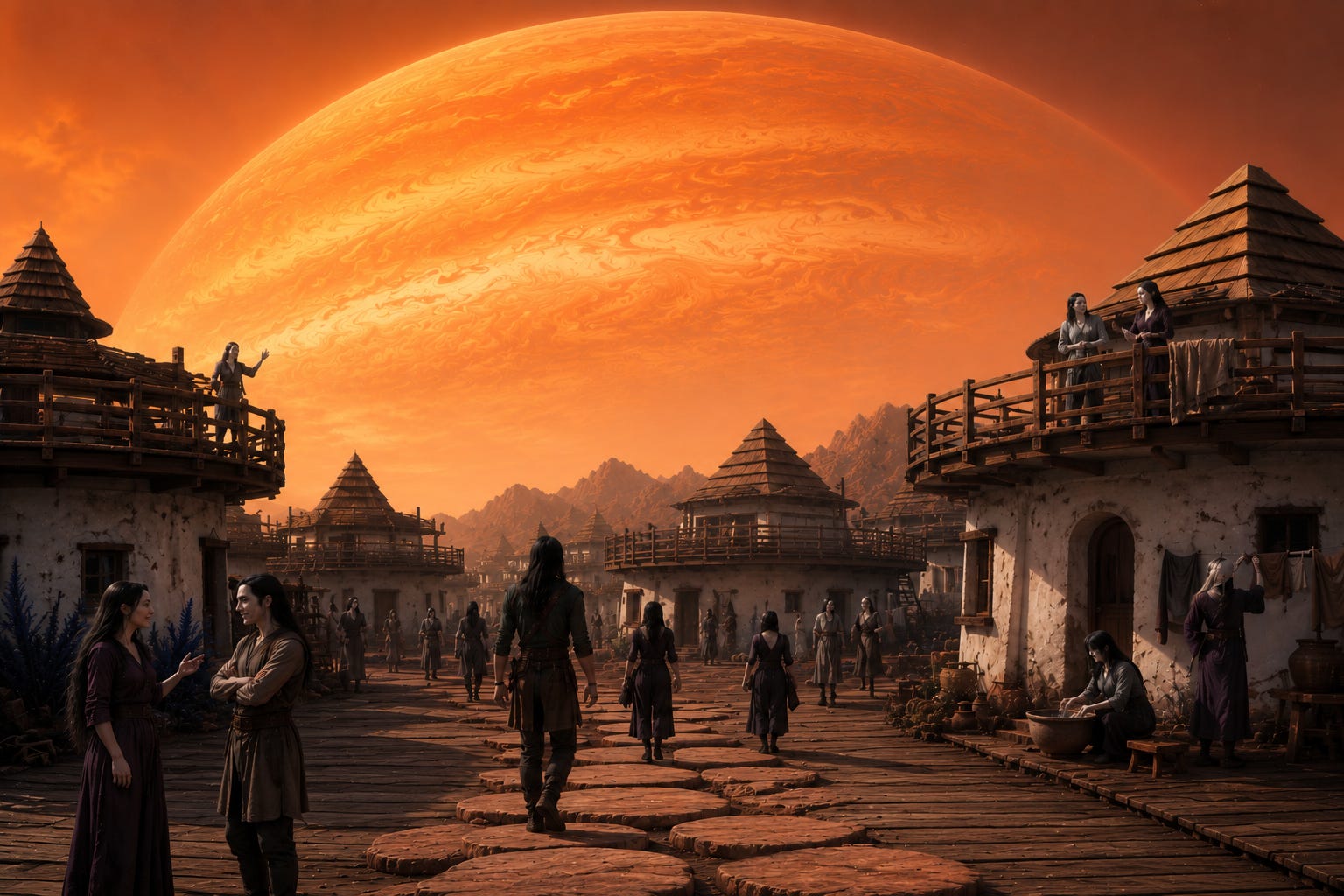
How do I describe what very well might be my home for the next several years? Zoas was a large moon orbiting a gas giant, and this giant was big enough to radiate heat. It wasn’t like a sun since there was no nuclear fusion, so Zoas was warmed by the planet in multiple ways. Again, I am no scientist, but as the Eagle Seven was flying toward the planet with the orange hue, Heath mentioned that there were several rings, much like the rings of Saturn, below the ship. We hadn’t noticed them before because of the tense nature of our prior conversation. Upon mentioning the rings, Heath tilted the craft downward slightly so we could see them.
I’d never heard of such a thing. It looked like we were flying over a sheet of glass, and the planet only appeared twice as large as the sun in Earth’s sky. The rings of this giant were many times larger than those of Saturn, and they merged with the planet’s equator. The whole thing was explained to me, but I hardly understood. The general idea was that the giant was pulling all the debris from this solar system toward itself. The moons, which were about the size of the average terrestrial planet, were being pulled toward the giant as well, but some countervailing force was preventing the larger bodies hovering above the rings from being pulled in as fast as the smaller debris. The end result was that the giant was burning and compressing the rings as the debris was being pulled toward the planet’s core, and this process was somehow creating a variety of glowing gasses that were warm like a vaporous fire and were essentially replacing the smoke. On top of this, the rings below the planets were mostly various forms of liquid, and therefore highly reflective. Basically, the warmth of the gases, the glow from those gasses, and the reflectivity of the rings was producing enough heat to create a permanently temperate climate on each moon, with temperatures ranging from just above freezing—with the exception of the northern poles which dropped below zero—and 70 degrees.
The end result was a mini solar system that looked like a collection of desert planets from afar, thanks to the orange glow produced by the giant’s gases, but these planets were really ideal for most species in the galaxy. The Droguldai got their badly needed orange light, and any other humanoid creature who breathed oxygen could live there as well. I could see why the Delvians and the Droguldai had chosen this system among the outer planets as their base of operations. A part of me also wondered if the confederation had some way of navigating through the rings of debris. If they did, they could launch surprise attacks against the Nordic Empire’s fleet as it flew in.
We landed in a level, vacant field. Once we’d all reached the base of the ship’s ramp, the first thing I noticed was that the grass and leaves were a dark navy blue. Again, it was always hard to tell the true color of things in the bizarre Droguldai light, but I do believe the foliage was all blue. I saw no flowers in the field, so I couldn’t yet say whether or not there were other colors on the planet. Mark led us to a path, but it was wholly unlike anything I’d seen before, and I honestly thought it looked rather dangerous and impractical. Our walkway was made of oval slabs of sandstone, each about four feet wide. There was no mortar connecting one slab to the next, and each rock seemed to have been hammered into the earth, which was a dark, brownish-red color. The slabs were uneven and at times porous, and as we followed the path, I kept waiting for one of us to trip.
No one did, and Mark eventually led us to a small town. On Mary’s planet, the buildings had all been egg shaped, from the tallest skyscraper to the simplest home. I’d come to suspect these buildings were Droguldai by design, and here I believe that suspicion was confirmed because the town was filled with Delvians, and the buildings were of a completely different shape and structure. The easiest way to picture these structures would be to think of a wide lid. Each home was a low, wide, circular cob house with whitewashed walls, much like the ancient humans lived in during medieval times. But instead of a straw roof of some kind, there was a wooden pyramid stacked on top of the structure. The pyramid was about a third of the size of the lower portion of the building, and on the sections of the roof the second story did not cover, there was a wooden railing. Apparently, the Delvians were very fond of balconies. Most of them stood on these flat sections of their roof, either hanging laundry or shouting at one another. I saw a man and a woman yelling back and forth from their homes, wrapped in some in depth conversation while the people on the street below walked between the pair hardly noticing the noise. I heard a lot of laughter, and despite the strange surroundings, I felt instantly comfortable there.
The Delvians themselves all had paper-white skin and charcoal-black hair without exception. As for their body structure, they were mostly around five feet tall but petite. In fact, they bordered on gaunt, and this made them seem much shorter than they actually were. The illusion made Mark, who was already tall by human standards, look like a giant among them. I couldn’t imagine such a frail race standing against the Nordics who easily cleared seven feet in height. Still, they were a very welcoming group. They saw us enter their small town, and many of them greeted us with smiles and nods, though they asked us no questions. I suspected that most of the people in this town knew Mark and understood that we were on an errand. Therefore, it would’ve been rude to delay us. But had we spoken to them first, I felt as if they would not hesitate to invite us into their homes. Every man and woman was dressed as if they were living in the Middle Ages, and it was easy to see where Mark had gotten his medieval-styled armor, but they were by no means poor. Both men and women wore jewels in their hair, hanging from a variety of pendants and clamps. Their tunics, trousers, and dresses were all decorated with golden embroidery, and they were all remarkably clean. Apparently, they took cleanliness very seriously. Though the town was something of a primitive encampment, the human equivalent of living in tents, the ground had been covered with thick wooden boards, save a few gardens in front of some of the houses. They were taking great care not to cake their boots and garments with mud.
“Did the Droguldai terraform this place?” Heath asked Mark. “Judging by the looks of it, your people haven’t been here long.”
“No,” Mark said. He looked at me. “This is your mission.” He pointed to a street further in front of us. “We tried to build you a church. It’s around that corner. Don’t know if we got it right, but, hopefully, it’s close. The people here are going to assist you in your missionary efforts. In fact, they already have. The natives of this planet are still very primitive, hunter and gatherer types.”
“What’s their race?” Helen asked.
“They’re humanoid,” Mark said. “Mostly. We call them Xtylars, but that’s not how they refer to themselves. We’ve only partially translated their language, and their race’s name has been a nuisance. They have a lot of tribes, and the tribes all have different dialects. If we move beyond the equator, we think we’re going to encounter whole new languages and races, just like Earth, but we’re just starting with one tribe, hoping to isolate at least one language pattern to go on. This group we’re working with stands at about four and a half feet tall, has light purple skin, red hair, and spikes on the back.”
“Are they using the spikes to breathe?” Heath asked.
Mark smiled. “Good catch. We think they might be a cousin of the Droguldai. Using external appendages to convert light into oxygen seems to be a foundational feature.”
Heath gave Mark a wry smile of his own. “Old Mad is probably hoping to get her people a race class. That would further distance them from the reptilians without admitting they’re amphibians.”
“You’re right,” Mark said. “But it wasn’t Madulluel. The Droguldai found this race while they were still allied with the Nordics. But they kept the planet secret because they didn’t want to invade a potential cousin.”
“But before that can become official, these people have to speak a common language and be given space tech,” Helen said.
“Which means this mission’s purpose is more than just religious,” Jill said.
“But how is that supposed to work if the Nordics overwhelm you and take the planet?” Cynthia asked.
“We don’t plan on losing,” Mark said. “But even if we did, all the planets in this system have the same race class, and they’re nonstrategic targets.”
“Because of the spears?” I asked.
“Partially,” Mark said. “These people are nowhere close to being a threat, and the planets would only be good for supplies, but the Nordics have plenty of that. The Nordics have judged that these planets are too far out of the way to make the supplies worth it.”
“But Earth is further from the Nordics than here,” Cynthia pointed out.
“Yes, but the Terras system is an intersection point, like a small town between two interstates. That’s why the Venusians were so powerful. The Nordics had to take out the Venusians first, and Earth was easier to live on,” Mark explained. “The outer planets are the outer planets because they’re out of the way.”
“Which is why you’re baiting them,” Jill said.
“Right,” Mark said.
“You going to use the rings?” Heath asked.
Mark laughed. “Don’t get ahead of me.”
We turned onto another street, and at the far end was a church that looked exactly like something out of a painting. I’d only been to Russia a handful of times, but even though I’d lived my whole life in the United Provinces, I still considered the mother country my home, and this little church felt like home. It was a regular, square building with multiple stories and an A-framed roof. It had lots of little rectangular windows, and although the building was made of the same white cob as the Delvians’ homes, in the middle of the structure, there was a proud, round tower with a black onion dome for a roof that even had a little cross on top of it.
I smiled. I couldn’t help myself. “You did just fine,” I told Mark.
I walked ahead of them, approaching the church in a sort of trance. I opened the black door and stepped inside, expecting to see something reminiscent of the protestants. Sure enough, there was no narthex, just a single large sanctuary, but, on the far end, was a dais, and, on it, stood a iconostasis complete with paintings of the saints. The church wasn’t perfect. There were pews, which was completely wrong, but to see an icon stand, something so familiar in the furthest reaches of space, was more than I could describe. I heard the others coming and wiped my eyes. Then I sat down in one of the pews to collect myself.
Mark and the others moved past me and stood in the middle of the sanctuary that was supposed to be a nave. The others looked around the place with mild indifference, but Mark turned to me and said, “I know it’s not perfect, but we tried.”
“It’s more than enough,” I told him. “Thank you.”
“We disagree on a lot,” Mark said. “But I believe God will reward anything done in faith. No matter how this war turns out, I think you’re going to make a difference here.”
“You’re a good man,” I whispered.
Just then, a strange-looking man wearing a monk habit similar to my own stepped out from behind the iconostasis. I was so shocked to see his attire that it took me a moment to notice his purple skin. He looked at Mark and me, uncertain, then he approached us. Mark shook his hand, and I saw that there were fifteen black spikes protruding from his back. The habit had been cut open to accommodate them. I wasn’t sure how I felt about that but supposed it was necessary. The spikes were uneven, some no more than two inches long, others over eight. They did seem to affect the young man’s posture slightly. He hunched but not much.
He turned to me, frowning, and said in very broken English, “I’m sorry, I can’t grow a beard.”
I blinked and fought the urge to laugh because the young man seemed genuinely afraid. “It’s alright,” I said. “What matters is you’re here.”
“This is Cooshda,” Mark said. “He’s going to be helping you with the Xtylars.”
“We’re going to feed them,” Cooshda said, growing excited.
“That’s right,” Mark said. He took Cooshda by the hand and motioned for him to sit in one of the pews across from me. It seemed Mark wanted to explain things himself since the man’s English was so broken. Cooshda sat down without a complaint, and looked at me, both eager and nervous. “Behind the church is a closed in yard with a gate. Cooshda and a team of Delvians have already been to the local tribes in the area, telling them that they can find food here if they grow too hungry. Since the Xtylars are hunters and gatherers, the tribes often fight over land, and somebody ends up losing. We’re hoping the ones who can’t eat will come here for food during the winter, which should start in a few weeks.”
“You’re still learning about them then,” I said.
“Can’t really witness if you can’t speak the language,” Mark said. “We’ve finally got our inside man,” he tilted his head toward Cooshda, “but there’s a lot of work to be done, and you’ll have to work fast.”
“Because of the Nordics,” I said.
Mark nodded. “I don’t think they’ll try anything before dealing with us, but just in case, I’d like to be able to speak their language before the battle kicks off because I want the local tribes inside the fort.”
“Fort?” I asked.
“That’s where we’re going next,” Mark said. “Cooshda will help you get settled when you come back, but first I want you to see the fort. If something happens sooner than expected, it would be better if you knew where to go. Plus, the politics of this whole thing might help with your work as well. You won’t just be dealing with my people. There’s other races helping with the campaign.”
“I was about to say,” Heath said. “Based on everything you’re telling him, it sounds like the Delvians are doing all the work. I thought this was a Droguldai project.”
“The Droguldai are funding the project. But they been contributing in other ways as well.” He shook Cooshda’s hand and turned to the group. “Let’s go. The sooner we reach the fort, the sooner you can get a better handle on things.”
May God grant you peace.
Hieromonk Nicholas Petrov
The Starward Exiles: Entry 1

My name is Nicholas Petrov. I guess you could say that I’m a Russian Orthodox priest, although, I grew up in the United Provinces, so our services are in English. Or they were before I left for the mission field. The truth is that I haven’t been to one of our services in a long time. Some might say this is why I’ve picked up a few supposed heretical vie…
