
The Starward Exiles Entry 15: Paragon (Serial Novel)

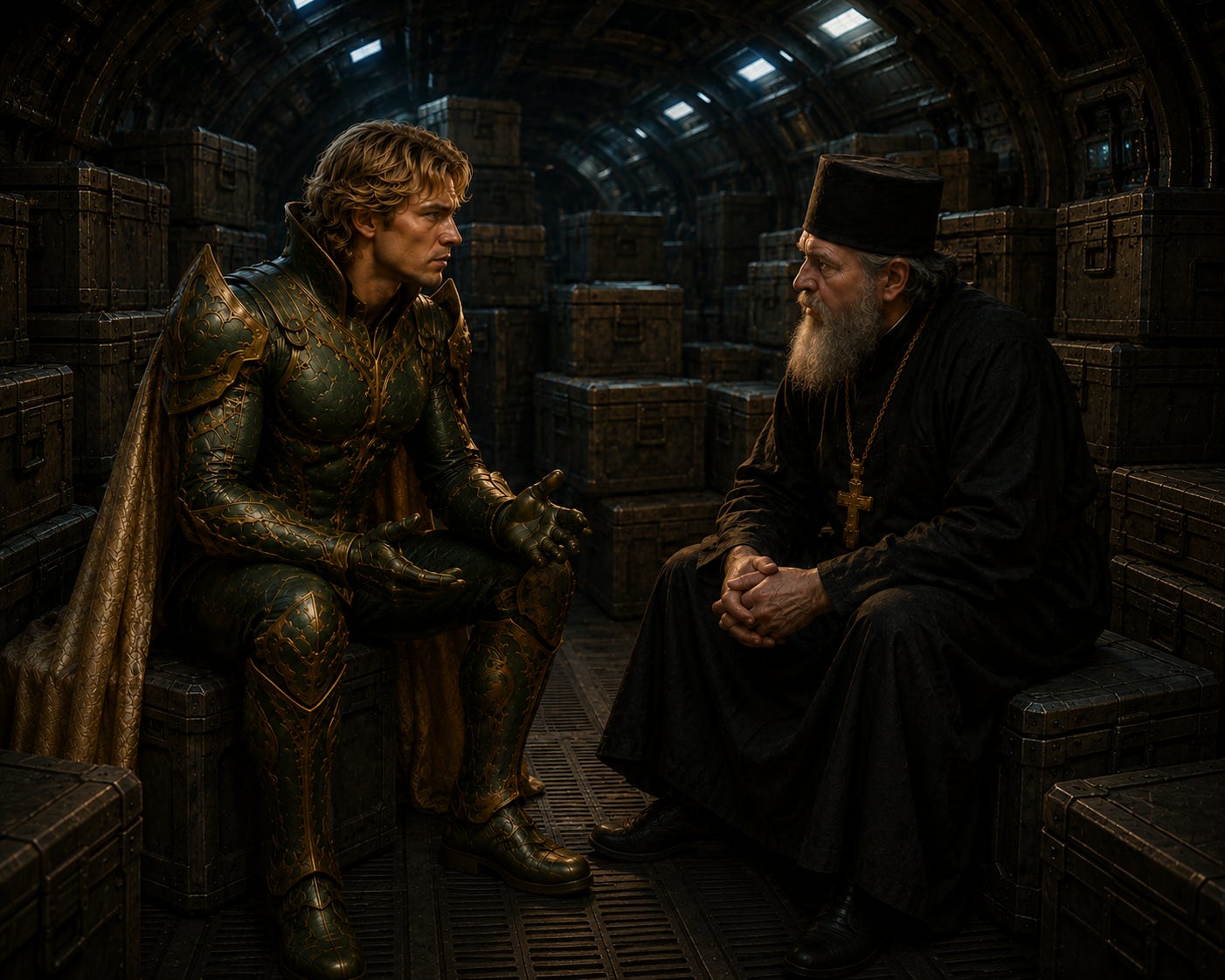
We loaded the freight onto the ship, and the Eagle Seven left Mary’s planet. Mark and the others went to the cockpit to discuss our detour. We were going to “clothe the naked.” I still had no idea what that meant. For myself, I stayed in the hull. Mary’s question and Jeena’s smile still weighed heavily on my mind. “How can God be real when there are situations that only leave you with sin?”
Was that true? Could Heath and the others have found a way to do the right thing? Was there a right thing under such ghastly circumstances? What if there wasn’t? How could God allow man with only evil, then fault him for it? I could not imagine such a thing. But then, why couldn’t I think of an answer for her? Was it just my mind, or was she right?
“Is something wrong?”
I looked up, and Mark, Madulluel’s soldier, was standing over me, smiling. He seemed to be trying to comfort me, but for some reason, the expression sent a wave of indignation through me. Pride, I expect. I took a breath, trying to force the wave of inexplicable rage down, and quietly said, “You already have a great deal on your mind.”
“I’ve got room for more,” Mark said. “But I won’t push.” He sat down on a crate across from me. The hull was practically filled thanks to Mark’s added freight. All that remained was a narrow walkway, so we were quite close, unlike Jeena. When I spoke to her, I felt as if there were a chasm between us. Mark went on, “What you’re about to see might be hard. I wanted to warn you.”
“I already know what the Nordics are like,” I said, tilting my head toward the cockpit.
“Ah yes,” Mark said. “I can’t imagine.”
“Nor can I.” For a long time, I said nothing. A part of me wanted to tell Mark my mind, but I couldn’t. Perhaps it was foolish, but I felt like a monk shouldn’t be expressing such doubts to a soldier. They have doubts enough. It didn’t matter. Mark saw me continuing to stare at the cockpit.
“Is it them?” he asked.
“What were they supposed to do?” I almost shouted. Then I bit my lip and looked away from Mark, ashamed.
“Become polygamists or die,” Mark said. “Give up their children or die. Disprove God by proving his morals impossible.”
“Madulluel told you?”
“I know the Nordics. They’re like Satan in their way. Entrap a man, then accuse him. Prove he’s less than a man by forcing him to behave like an animal. It’s what they do. But they forget Esther.”
“Esther?” I asked, feeling offended that he’d used her name. I can’t account for this antagonism that had settled inside my mind. Had Jeena defeated me so completely? Then I blinked. “You’re a Christian?”
“Not your variety. Non-denominational, at least until I was abducted.”
“You were abducted?”
“Yes. But God was kind to me. I escaped. With a Grey.” Realizing that I was about to hear the young man’s story, I said nothing and motioned for him to go on. Mark continued, “The Nordics are wrong, you know. They aren’t the first to force people to sin, to dehumanize humanity. The only difference is that Xerxes didn’t have lasers. And Greys can heal. You know their lore?”
“Yes. A Grey is a later generation of the infected races used by the Nordics for the first part of their invasion.”
“And along with their perfect bodies so goes their minds,” Mark added. They become a shell of what they were both inside and out. But they can come back if God allows it.”
“You’re saying the Greys can break their programming?” I asked, shocked and skeptical because I’d never heard such a thing before.
“I’m saying I was sitting inside a large cell when a Grey was thrown in with us. Everyone stayed away from him, but I was fourteen and not really interested in the history of the first Nordic War, history in general for that matter. I suspect they planned to sell him with the rest of us. Of course, knowing what I know now, the Reptilians were hoping nobody would notice that he was broken. We began talking. He told me he knew how to fly the ships, and if we could just break out of the cell, he could take us to the hanger and steal one of the smaller craft, the saucer kind. You know them?”
“Yes.”
“So, I managed to convince the others to trust him. We couldn’t break out during the feedings. They passed our food through the doors, but the Reptilians can’t resist their experiments, nor their decorations. Before the sale, they take the prisoners and make them “presentable,” remove the fat, change the hair, add a tale, tattoos, whatever they think will sell on the planet they’re going to. The Grey, I later called him James, knew all this and told us about it, so we hatched a plan. We waited for them to take us to the operating room, then we rushed the guards, grabbed their guns, and stole a ship. He knew how to deactivate the shield, fly the craft, all of it.”
“He just needed the muscle,” I said.
Mark nodded. “They should’ve known better, but they’re so arrogant, like Satan. Yes, anything with a will can force it on others. God gives them that right. But God can use anyone anywhere. I don’t know if James woke up because he wanted to, or if he was the only one willing to, or if God did a miracle. What I do know is that they didn’t see it coming. And neither did Haman. Even in sin, God can still move.”
I nodded, though I felt frustrated. The answer seemed so simple, but it did nothing to address Mary’s pain. Was pain just the price of free will? “Is it worth it?” I asked, more to myself than to him.
Mark seemed to understand my question. “What if because of his pain Heath becomes an Esther or a Joseph and saves his people from annihilation? Will it be worth it? Maybe not for him, but for the millions spared, I’d say yes. I can’t compare myself to Heath. But I do miss my parents and friends, and yet, at the same time, if I wasn’t abducted, I never would’ve met James. I never would’ve been taken to the Delvians. They never would’ve trained me, and I never would’ve had a chance to see what Heath is made of. We wouldn’t be flying to liberate a whole planet, hopefully. Whatever happens,” he tilted his head toward the cockpit, “that’s why I’m fighting for them and what they went through. Because maybe sparing other pain might justify my own.”
“And if we fail?”
Mark shrugged. “Perhaps even that serves a better plan. Who can say?”
He stood. “We’re about to meet a lot of people who need hope, who need to remember that even a Grey can be human. Think on it a while.”
Mark returned to the cockpit.
I continued sitting in the hull. Mark’s story sounded good, but he hadn’t heard Mary’s voice, nor had he seen her pain. He hadn’t seen Heath speak to a daughter who knew too much for her age. The hypocrisy made me angry, but there was no help for it. I was a monk. I’d spent my life studying the Bible in the academic sense. I knew about Esther and Joseph. I knew the doctrine Mark was teaching, but it still felt hollow. The most I could say was that I didn’t think compulsion and its consequences would be held against my crew and those like them, but what about the pain? I guess that was my real question all along. Would the pain be worth it? I guess I’d just have to see. If we won.
Again, days, perhaps weeks, passed as one endless moment. Finally, I felt the ship lurch to a stop as I was sitting in the hull, writing and contemplating my conversation with the young soldier. Mark entered the hull first, followed by Heath, Jill, Helen, and Cynthia. I stood and followed Cynthia without a word.
Before opening the hull door, Mark turned to us and said, “Please say nothing if you can help it. The people trying to end this situation are already under tremendous strain. Guilt or anger will serve no purpose here.”
With that, he turned and opened the door. A heavy mist filled the hull, not a fog, but droplets just large enough to bead on the clothing and skin. As we walked down the ramp, I noted the bluish-grey overcast that hung in the sky. Between the clouds and the mist, there was a heavy, oppressive feeling in the air, like we were walking through a cold stew. At the base of the ramp stood two figures on top of a barren, muddy plain. One was a blonde-haired woman wrapped in a wool blanket. The other was an alien man of a species I’d never seen or heard of before.
I hate to use this comparison, but the man reminded me of a monkey, an emperor tamarin to be more precise. He was thin, fragile-looking, and slightly taller than a Grey, which is to say he was about four and a half-foot tall, but he hunched slightly. Had he straightened, I would’ve guessed him to be closer to five feet. Below his bottom lip was a white mouche—what was once called a soul patch—which hung past his chin, but as for his mustache, it did not grow above his upper lip; rather, it sprang from the sides of his nose, just above the nostrils. The two segments of the mustache grew past his cheeks and curved until they both almost touched the base of the man’s chin. His eyes were human; that is to say, they had whites and blue irises, but their shape was more round than oval. His hair was white and parted in the middle, but it was clear that the hair was not human. It was more akin to a pelt, and the part down the middle wasn’t a choice of style but a clear divider between two segments of fur, which did not lie flat on his head but stood tangled like the fur of a shaggy dog.
Indeed, my suspicion about the hair being more animal than man was confirmed when I looked behind the gentleman and saw the guards standing behind him and the woman. They too had the odd hair and the facial hair as well. Therefore, the white color was not due to age but was the natural color of the hair of this race.
The man’s skin color was an olive tone, and his attire almost reminded me of a bath robe. He wore a long purple overcoat, cinched at the waist with a belt of the same material, and under the robe was a tunic dyed a lighter shade of the same color. Both the robe and the tunic stopped just below the knee, and the rest of the man was concealed by a pair of high black leather boots. As for the guards, they were dressed similarly to Dutch pikemen, wearing a purple coat, which was buttoned and hung below the knee, and also the black boots. Their hats seemed to be made of leather, with the brim folded tight against the crown, leaving two points at the front and back.
The soldiers also carried long poleaxes, but I could also see these axes were ranged weapons as well. Instead of a Dague, the spike above the axe head, there was a barrel, and several rings of crystals ran up the barrel’s shaft. I couldn’t see the trigger of the weapon, but I suspected it was somewhere along the shaft of the pole. The soldiers were using some variation of the crew’s plasma rifles. The crystals were a different color, neon green instead of purple, so I was confident the weapons worked a little differently, but the kind of ammunition had to be something similar. Given the fact that the soldiers hunched almost as badly as their master, I suspected that the weapon was laid flat on the ground, the axe doubling as a sort of monopod for the barrel, and the men fired their weapons while lying in the dirt. If their enemy closed the distance, the axe would then become their primary weapon.
“I tried to cover her up like you asked,” the man said to Mark. “But if the Nordics arrive, she’ll have to remove the blanket.”
“If the Nordics arrive, you’re already in trouble,” Heath said.
“We’re popular,” Helen added.
“You must not be very good smugglers then,” the man said dryly.
“They’re popular,” Mark said. “The ship isn’t. Not yet.”
Mark walked to the base of the ramp, shook the man’s hand, hugged the woman, and nodded to the three guards behind them. He then walked back up the ramp and motioned for the five of them to follow him. They did, and once inside the hull, Mark directed everyone to sit on the crates.
Mark pointed to the old man. “This is Hapha, the slave master. He then pointed to the woman in the blanket. “This is Nella, his . . . forgive me, I don’t know the term.”
“I keep him warm. His race sleeps in packs, but they can’t here,” Nella said.
“Like Abishag and David,” I noted.
Nella nodded. “The position is called ‘chief slave,’ but that implies I oversee the operations in the mines, which I don’t, so I guess there really isn’t a name for it.”
“But she does oversee the mansion, which is why she’s here,” Mark said.
“So, this is a mining planet?” I asked.
“Meltar,” Hapha said.
My eyes widened. In our current age, there are different ways to create energy and shields. Some are more dangerous than others. Terras’s technology relied heavily on radioactive elements. Other civilizations relied on what are referred to as converter elements. That is an element that can cause another element to, in a sense, become radioactive, forcing it to break apart faster. The ships would use this forced radiation to power their shields and the antigravitational components of their craft. However, Meltar was stable, meaning it did not require special housing to protect the crews against radiation. But not only that; it was also the only fuel, if I may use the word, that could power a particular kind of shield for a long time. There are different types of energy shields, wave shields, light shields—the Nordic’s variant—gravitational shields, and so on, but Meltar could power what is called a plasma shield, and it lasted far longer than all other forms of radiation. A plasma shield was the hardest to break, and it was also malleable, meaning an electric current could pass through it to let armies and craft enter and exit a vessel.
All carrier class ships have a plasma shield in both the Nordic Empire and the Terras Confederation. They’re a necessity for letting fighters pass in and out of a vessel. But here’s the issue. While I’ve said that the plasma shields are the hardest to break through, that is only so long as there is enough energy to support them. With most forms of radiation energy, a Nordic laser could hold the beam over the plasma shield and break through it in about ten minutes. After that, the carrier would be forced to rely on a secondary shield, using wave or light technology depending on the environment. These shields last longer, but the commander is put in a difficult position. He must decide whether to let down the plasma shield in five minutes or seven, and this decision determines how long his secondary shield will last because the Carrier is pulling energy from the same source. Plus, the moment he puts up the secondary shield, he may be able to fire projectiles because missiles can pass through the secondary shields at close range, but he can’t use lasers, and he must let down the shield in order for the fighters to return to the ship, and if the battle isn’t over before that happens, then the carrier is vulnerable. And since most carriers rely exclusively on lasers, the moment the secondary shield is implemented, the vessel is reduced to a non-combatant unless it wants to risk lowering the shield to join the fray.
This whole situation had put both sides in an interesting spot when it came to Meltar. Granted, it could sustain a plasma shield for a much longer period of time—how long has yet to be determined—but it couldn’t be used for the other shields because it made them too dense. Projectiles couldn’t pass through them, let alone lasers. So, to use the Meltar, both sides would have to renovate their ships so that the Meltar could be used for the plasma shields, and the radioactive elements used for the secondary shields. So far, no one has done this, but then again, Meltar was supposed to be rare. No one had ever heard of a mining planet filled with Meltar. Now Hapha was telling us that not only were the Nordics actively mining it, but they also had control of a planet filled with the substance, which could only mean that they planned to use it at some point. This would win them the war.
“Meltar,” I breathed. “Have they redone their ships?”
“Not yet,” Hapha said. “They’re in the experimental phase. It’s been shown to power the shields, but the precise amounts required for each ship and the burn rates under different conditions are still being worked out. I’ve also heard that they are conducting other experiments with it, but I’ve learned nothing of their progress. Right now, they’re just collecting it.”
“Which is why we need to work fast,” Mark said. “We’re ahead of them on a few points, and we’ve found a use for it of our own.”
“We? Who’s we?” Heath asked.
“The Delvians,” Mark said. “Earth will have to thank us eventually. The Droguldai already have, although they still refuse to join the cause without a definite win, which we plan to give them.” He looked at Heath. “If the win is big enough, I might be able to persuade Madulluel that a political marriage isn’t necessary, but obviously I can’t promise anything until after the battle.”
“Taking a mining planet filled with the most powerful fuel source in the Milky Way isn’t a big enough win?” Heath asked.
“This isn’t a battle,” Mark said, smiling slightly. “This is a slave revolt.”
“And why should we trust this guy to pull that off?” Heath asked.
“Yeah,” Helen said. “Your race has been under their thumb since the first Nordic War.”
“Look at me,” Hapha said, motioning to his body. “You think I want to be ‘under their thumb,’ as you say? I didn’t want to be a slave master. I never asked for this position. I was told to fill a quota or else. The Arshtyie were peaceful. But we can’t even stay warm by ourselves. Our weapons barely set their cloaks on fire. And we’re small, so small. How could we hope to stand up to them?”
“If you’re so weak, then why haven’t our people revolted?” Helen asked.
“Because we’re naked,” Nella said. She was trying to sound patient, but I could tell she was angry, and as I looked at the way she was glaring at Heath, I realized she was angry with the crew, not her condition or her master. “They strip us and let the elements do the rest. They gave us a few mud huts in something that resembles a town. That way we can stay dry and die slowly instead of all at once. And if Hapha just gives us shoes, they’ll kill him; they’ll kill me; they’ll kill everyone. And even if we did revolt, where would we go? There aren’t any ships here, and the Nordics always come back. They’re always checking.”
“Which raises a couple questions,” Heath said. “What’s in it for him? And why now?”
“The answer to both those questions is Nella,” Hapha said. “She converted me.”
I looked at Mark, who was looking back at me and smiling. I could almost hear him asking, “So, is she Joseph or Esther?”
Mark stood and looked at Heath. “I vouch for this man, and we’re here, so we may as well play our gambit.” He looked at Hapha. “I want you to take the metal crates to the slave town and trade out the clothes and rifle parts for the Meltar.”
“Rifle parts?” Hapha asked. “Not full rifles?”
“Your people have been beaten and are untested. If they won’t take the time to put the rifles together, they won’t fight either. You have to make sure they want it, and I also have to make sure they won’t use those rifles on you.” He looked at Nella. “Is the ammunition ready?”
“Yes,” she said.
“Why are you asking her?” Cynthia asked.
“Why wasn’t I told this?” Hapha asked.
Mark smiled. “She’s saved her people indirectly. I thought it was only fair that she also give them the means to fight for themselves. I also didn’t know Hapha as well as I do now. I wanted to make sure he didn’t take the guns once they were finished with his poleaxes.”
“I would never!” Hapha roared.
“I know that now,” Mark said, still grinning. “I was simply trying to make sure we all needed each other. The tools and manuals are in the clothing. If the slaves complete the task, they’ll come to you. Have your men check the rifles, then Nella herself will give them the ammunition.”
“I’m sorry I didn’t tell you,” Nella muttered.
Hapha looked at her and melted. His eyes fell to the ground, and he said, “I understand. If the Nordics had come at the wrong time, they might’ve forced me to give them everything. This way, if someone shows up before we’re ready, then perhaps you and a few others can hide with some of the weapons and survive until help arrives.”
Mark moved to the crates, grabbed a drill that had been resting on it, and unscrewed the lid. He pulled out one of the garments, setting the rifle part to the side. “I think the first honor should go to you, Nella.” He tilted his head to the hallway leading to the crews’ cabins. “There are rooms back there. Let’s see what it looks like.”
Nella stood, took the garment, and entered the hall. When she returned, she was wearing a white tunic that came down to her knees. It looked like something the Greeks might’ve worn. Her smile was lovely as she wiped tears from her eyes.
“Looks a little stiff,” Helen said, squeezing the garment in her hand. “I thought it felt weird back at the warehouse. Is it even fabric?”
“It’s fabric,” Mark said. “But the Delvians covered it in a laminate that will reflect the Nordics’ lasers, at least for a while. It’s not much protection, but it should take them by surprise, and that should be enough.”
“Thank you,” Nella said, softly.
Mark nodded, then turned to Hapha. “One last thing. I’d like to speak to the slaves before I go.”
Hapha blinked. “I can’t take you to the mansion. There may be spies.” He thought for a moment, then added, “But there are some caves that lead to the tunnel, and that leads to the balcony over the town. It’s where I give orders.”
“That will work,” Mark said.
“I’ll come get you when the slaves are ready,” Hapha said.
Hapha and Nella said their goodbyes, then they and the guards left the ship. Some time later, guards arrived and unloaded the metal crates. More time passed, then Hapha and Nella—still wearing her tunic—came for us. They led us down a wide muddy plain. I had to lift my habit almost to my knees to keep it from becoming caked in the mud. Soon, we were led into a cave that turned into a tunnel illuminated by oil lamps. Before long, the rock walls became wood, and some time after that, we were led outside to a balcony overlooking a horde of humanity standing in front of a collection of mud huts that looked like something from ancient times.
Everyone in that massive crowd below us wore not a stitch of cloth, but it hardly mattered because they were caked in mud from head to toe. However, I did see white in the crowd. Some of them were holding Mark’s garments, and they were looking up at us with wide eyes.
Mark did not hesitate. He stepped forward, taking Nella’s hand and making sure she was standing next to him in her tunic. They stood together at the edge of the balcony, and Mark said, “What some of you hold in your hands is life or death. I suppose you could bury the parts and clothes if you wanted, but if the Nordics find a single item, you will die. I say this to frighten you. And to make you angry. In your hands is the means to find a little warmth, and yet those same hands tremble. What have the Nordics done to you?” The clouds began to churn above us, and thunder rumbled in the sky. Mark did not notice. “The Nordics believe that if they remove the trappings of the body, they can destroy the man, but I don’t believe this. The Bible says man is made in the image of God, but God does not have a body, so how? How is man made in the image of God? I say this. Inside every man, God has revealed pieces of his very nature, beauty, mercy, justice, love. All these things a man can understand in part. They shake his soul. Move him to love his children, even in a mine. And I say that your hands don’t just tremble in fear; they tremble with desire. Some part of you knows what has happened is an injustice. It screams against the very nature of God!” Lightning flashed through the sky as Mark drew his sword. “So, are you going to let the Nordics reduce you to animals, or are you going to put on your garments and become men!”
Then the rain fell, and no one spoke. No one clapped or cheered. But one man put on his tunic. Then another and another. Metal pieces splashed in the mud, and the slaves picked them up and lifted them into the air as the lightning flashed around them. Then there was a cry, not a cheer, not a chant, a single moan that rose into a roar filled with grief and rage. There were no words, just a long, agonized scream of defiance. The rain continued to fall, and as the mud melted from their bodies, I saw men.
May God Grant You Peace.
Hieromonk Nicholas Petrov
The Starward Exiles: Entry 1

My name is Nicholas Petrov. I guess you could say that I’m a Russian Orthodox priest, although, I grew up in the United Provinces, so our services are in English. Or they were before I left for the mission field. The truth is that I haven’t been to one of our services in a long time. Some might say this is why I’ve picked up a few supposed heretical vie…
