
The Time Machine (1960): Two Meetings and One Big Flashback
In Part 1 of my four-part review of this time travel classic, I look at the 19th century novel that started the genre and the movie that followed


Over the last several months, I’ve talked about time travel. Originally, I’d planned to discuss the trope in more detail — when and how to use it, when and how not to use it, and whether it was better to rely on fate as a stabilizing force in the narrative. Or is it better to play around with various paradoxes? But then I realized that no in-depth discussion about the trope would be complete without reviewing the novel and subsequent movie that started it all.
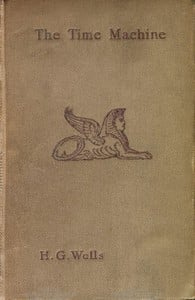
The Time Machine (1895) by H.G. Wells (1866–1946) can only be described as the most notable work on time travel. In fact, Wells is often thought of as the man who invented science fiction itself. He wrote about mad scientists, traveling to the moon, an alien invasion, and, of course, the time machine.
A portentous meeting
There are several important differences between the movie and the novel, and we’ll cover some of them, but in both cases, it all starts with a meeting. The book opens with the first meeting, while the movie only covers this initial gathering during a flashback. But in both cases, the “time traveler” reveals a miniature version of his machine. In the book, he is only referred to as the time traveler, while in the movie he’s referred to as George (a nod to Herbert George Wells).
When the machine is activated, it disappears. The time traveler announces that his invention is now traveling through time. Of course, his friends are skeptical, and everyone except Filby is outright dismissive.
In the movie, all the friends save Filby leave. Filby asks the traveler why he even wants to go back in time. The traveler simply says that he is unhappy with the time he was born in. Because this movie was shot during the Cold War (1946–1991), he expresses contemporary anti-war sentiments. But Britain is portrayed in the film as being at war with the Boers (1899‒1902), which is consistent with the time period of the novel.
The traveler then asks Filby to return with their friends the following week. Filby agrees but, suspecting that he is about to do something dramatic, asks him not to leave the house. The traveler dodges this request by saying that he will not walk out the door. Filby is not satisfied with this answer, but leaves nevertheless. The traveler, of course, goes to his lab, determined to test his invention. He goes off on his adventure, and the rest of the story is told through a flashback during the second meeting the following week.
How it works as a story trope
From a narrative standpoint, I both like and dislike this flashback approach. On the one hand, the choice to tell the whole story as a flashback deflates the tension because the time traveler has obviously returned. So the audience knows that he has survived his harrowing ordeal. On the other hand, his clothing is in tatters, and he’s famished, so the audience is still curious to know what happened.
For myself, there were moments where I was bored because I knew the time traveler was in no real danger. But then there were also times that curiosity about what was going to happen next did grab my attention. So, all I can say is that I have mixed feelings about this setup: it works and doesn’t work at the same time.
Avoiding time travel pitfalls
However, one of the narrative strengths of The Time Machine, both book and movie, is the simplicity of its premise. It avoids the many pitfalls of time travel tales by going into the future and staying there. It does not play paradoxes and try to dazzle the audience with circular reasoning, as we see in many time travel movies.
Plus, the idea raises an automatic, fascinating story question: Can the future be changed? That question doesn’t have to be addressed directly, but the audience will still be compelled to ask. This works in the story’s favor because the worse the future seems, the more the audience will ask, “Can we prevent it?” I suspect this was the true hook H.G. Wells was going for.
A careful approach to time periods pays off dramatically
And one advantage to placing the story in the late nineteenth century is that — in the film at least — the time traveler has the chance to react to later events that the 1960 audience is aware of. The writers of the screenplay take full advantage of this, even going so far as to place a mannequin outside the time traveler’s door so he can see the rapidly changing fashion trends. In the book, by contrast, the time traveler pushed the throttle to its max and was almost instantly taken into the future.
This is an instance where I preferred the movie’s approach because, in the film, the audience sees the traveler learning to operate his invention. He stops when the windows of his lab are boarded up.
The year is now 1917, and after having a brief conversation with Filby’s son, the traveler learns about World War I. Sadly, Filby was killed during this war. Grief-stricken, the traveler returns to his machine and continues his journey. He stops again when his house is bombed during World War II.
Then he makes a third stop in the year 1966, where the knowledge of the screenwriters of a 1960 release fails them.
Here, the fears of the Cold War are in full display, and the traveler’s hometown is hit with a nuclear bomb. However, during this time the effects of a nuclear weapon were not well understood. The explosion from the bomb sets off a volcanic eruption, and the traveler is encased in lava. Only his machine, which continues traveling through time, saves him. This whole scenario may seem odd to modern audiences, but it does speak to the prevalent fears of that period in history.
And then the future appears
The time traveler is forced to continue his journey until the lava surrounding him erodes. When it finally does, he sees futuristic buildings appear and begin to decay. At this point, he stops his machine; however, he does so too rapidly and is thrown to the ground. He finds himself in a clearing next to a giant Sphinx-like construction that has a set of large doors at the base of it. The time traveler stands and rights his machine. The date is October 12, 80 2701. We’ll cover what happens then next time.
“If you’d like to read more of my work, The Familiar (a dark urban fantasy) comes out February 3rd, 2026, and now available for preorder on Amazon and Draft 2 Digital. Gerome is a Familiar who gave his blood to a vampire. But now the vampire wants his wife. This book is the first of a larger series called Annals of S.O.L.M. If you’d like to support my work, The Familiar will be found on Amazon, Apple Books, Barnes & Noble, and more. I hope you enjoyed this entry of The Starward Exiles.”
