The Starward Exiles Entry 5
Meeting a Droguldai

After writing my last entry, I was quickly summoned to my first meeting. To properly understand it, I must first describe the race sponsoring my mission, the Droguldai.
Notes on the Droguldai
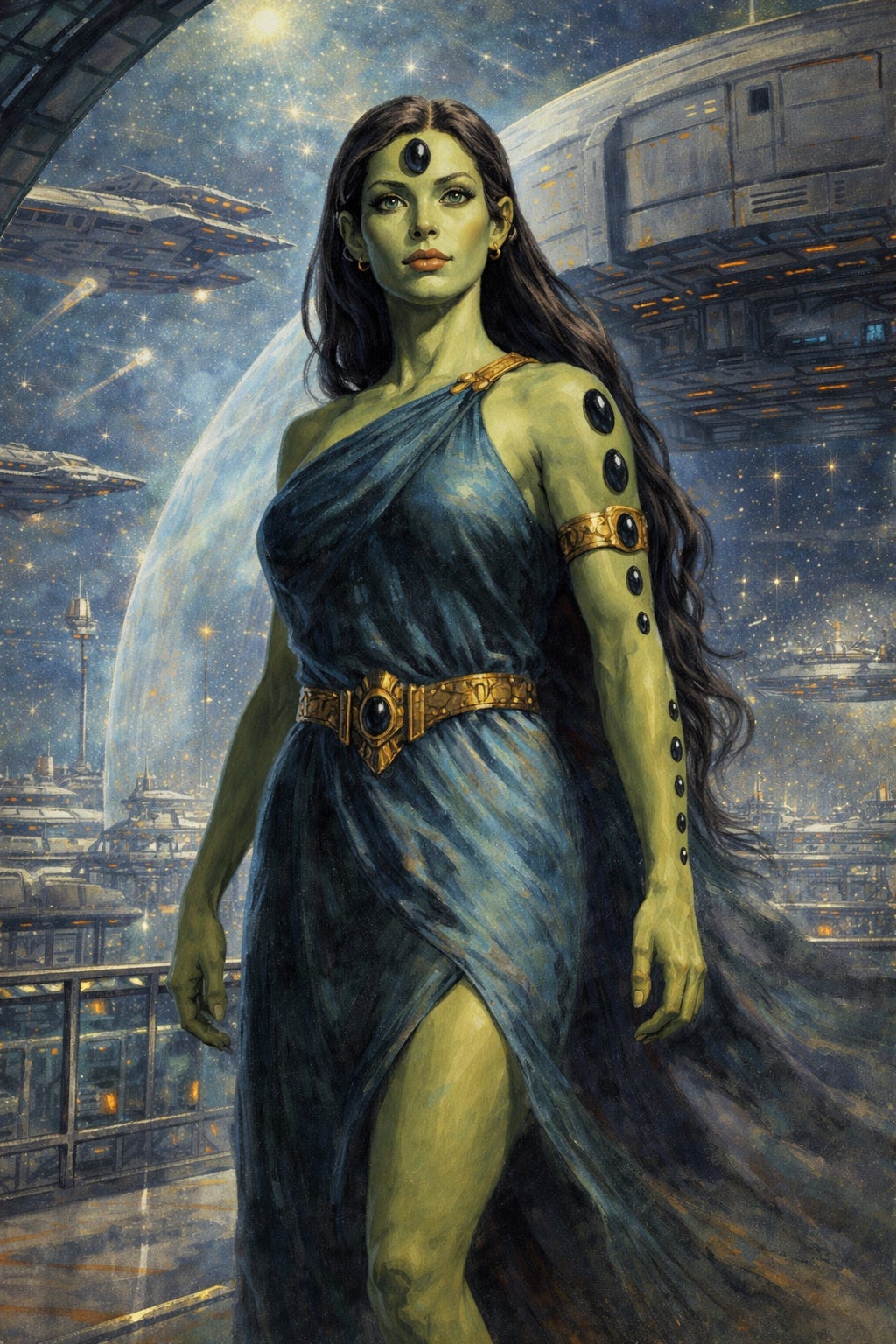
They are strictly speaking considered an amphibious race, but there is some debate about whether this is an accurate classification. First of all, they live on land, and although they can survive much longer underwater than a human, the way they breathe does require them to spend most of their time on the open air, so their civilization remains on their continents, rather than below the water as is the case with most amphibious races. In terms of their shape, they are humanoid and have light olive-green human skin, as opposed to the tough leathery flesh commonly associated with the amphibians. Their eyes have whites, blue, green—true green, not hazel—brown, golden, and orange irises, and their pupils are vertical slits. Their hair colors consist of all the traditional human shades, save blonde, but they also have blue and green shades as well.
Their most unique feature is the black oval stones, which are located on their foreheads, backs, and arms. I call them stones, for that is really the only way to describe them. In terms of their texture, they feel like smooth marbles, but as to the way they grow on their bodies, they’re more like teeth, that is to say, a sort of living bone with an enamel and nerves. These black stones can be moved like teeth as well. In fact, the surest way to identify a Droguldai of high class is to see if the stones on their back are straight. In their culture, they have what can only be described as braces, only they look almost like a bike chain, and they wrap around the six stones running along either side of the spine. These braces are put on the high-class children when they are around six or seven years old, and over the course of a couple years, the stones form two neat rows, in the exact manner as teeth being straightened in the mouth. So, a wealthy Droguldai will have straight stones on the back, and the poor Droguldai will have stones that are positioned randomly along the spine. The purpose of these stones is quite interesting. The Droguldai need oxygen in the same way a human needs oxygen; however, they don’t breathe oxygen in through the mouth. The stones, somehow, capture the UV from their sun, which is an orange dwarf, and convert the UV into oxygen. No one is sure how this is done. The oxygen does not exist in a gaseous state but merges with the blood cells, where it functions just as oxygen does for a human. The Droguldai do have a pair of organs shaped similar to lungs, and part of this conversion process takes place within them, but again, no one knows how this is done because good luck convincing a Droguldai to allow you to dissect one of his peers.
I bring up these distinctions because it’s important to understand that every other aspect of this race is identical to humans, but although the humans classify them as amphibious, the Droguldai consider themselves Reptilians. While we identify a Reptilian primarily through their scales and teeth, the Droguldai emphasize two factors in combination with each other. Essentially, the fact that they have silt irises, and the fact that they do not dwell in water classifies them as Reptilians. Basically, we would consider them to be like frogs; they consider themselves to be like lizards, or perhaps they would consider a newt a type of lizard.
This sort of taxonomical debate might seem pedantic, but it’s important to understand because the Reptilians consider anything they cannot interbreed with to be inferior to them. And for a long time, the Droguldai considered humans to be an inferior race for this reason. The Droguldai were actually one of the primary races the Reptilians sold humans to during the newest round of abductions kicked off by the current Nordic War. But then something changed, and, perhaps by Providence, I have been allowed to meet the cause. In fact, these figures could become a desperately needed hope for humanity.
End of Droguldai Notes
As I finished writing my previous entry, Heath Lee’s shadow loomed over my journal. His soft but rugged voice muttered that it was time to go. I stood, turned, and regarded the man. This was the first time I’d seen him. He was a little shorter than me but stout, that is to say, broad-shouldered with legs that seemed almost too short for his torso. He was a muscular man, unnaturally so. In past times, one would’ve assumed him to have taken hormones or drugs, but in my time, when one sees someone in such a condition, it is safer to assume that they’d been altered.
I’d already met the three women serving as his crew, and they were also altered as well. They were beautiful, but in a way that seemed almost synthetic. What I mean is that they had no freckles or blemishes, and their shapes were well proportioned but uniform, as if they’d come from an assembly line. The obvious inference would be to assume that they’d been altered for breeding, but they did not confirm this intuition back on Earth, and clearly, since meeting them, I have not pressed the matter.
Heath and I crossed the cargo hold to the back of the ship, and when the bay doors opened, Cinthia was standing on a dock inside a large spaceport. For as much as the Droguldai resent amphibious comparisons, their technology largely resembles the advancements of that class of races. A Droguldai spaceport can best be described as a floating pier in the void. A metal dock extends from a massive rectangular ship. Smaller docks branch out from this main platform, and even smaller docks branch out from those until the whole thing resembles a metallic, two-dimensional tree. Ships of varying sizes hover beside these docks or attach themselves, either through magnetism or robotic clamps. I believe Heath’s ship, Eagle Seven, uses magnetism.
Also extending from the massive rectangular ship is a sort of membrane that can really only be described as a massive bubble. It arches over the port, starting from the top of the rectangular ship, and forms an enclosed sphere, merging with the rectangular ship’s base. Oxygen is pumped into the bubble, and this I find truly fascinating. The entire rectangular ship is made of the same material as the stones that grow from the Droguldai’s bodies. I don’t know if they harvest the stones from their dead, or if the stone is also a kind of ore found on their planet, but either way, the entire ship is comprised of this ore, and it converts the unfiltered light of the nearest sun into breathable oxygen. Most of the races found in the Milky Way breathe oxygen; there are exceptions, and I’m sure accommodations are made for them, but the majority breathe our air, making the Droguldai’s unique ability particularly valuable. Their ports have become the chief way stations in the galaxy. The ships are able to fly through the bubble, almost like a man pushing a pin through a balloon. The surface breaks enough to let a solid object pass through without letting the oxygen escape.
As for how they heat this massive bubble, I must admit that I don’t have an answer. My theory is that the process of converting light into oxygen must produce heat, and this byproduct is used to bring the temperature of the bubble to a tolerable level. The port was still uncomfortably cold, around twenty degrees Fahrenheit, but a man can stand outside and survive.
We met Cinthia on the dock, and Helen and Jill joined us a moment later. Identical proportions or not, the women have easily distinguishable personalities. Cinthia, a girl with curly red hair and dimples on both cheeks, stood smiling as if she hadn’t seen us in a week. She’s very childlike and acts particularly naive. However, I suspect this to be a deception. During our journey from Earth to this way station near Neptune, she’s said subtle things that make me believe she’s exceptionally perceptive. She seems to read people’s moods and works to deescalate conflicts before they begin. Helen stood beside Heath with one hip jutted to the side and a sly grin on her face as her brown hair covered one eye. She is the sarcastic one of the bunch, with a dry wit that slices like a scalpel. I have seen her words cut sharp enough to make someone as cheerful as Cinthia wince. The woman stood several steps away from us, as if she were afraid she was carrying a foul odor. Her eyes were cast downward, and she stood with her arms crossed over her shoulder. I know the reason why. Of the five of them, I know the most about her story. She was subjected to slave trade and has been inflicted with a disease of a sensitive nature. This disease is alien in its origin and is known to kill human men within a matter of weeks and human women within ten years. In short, she knows she is going to die, and she wears that knowledge like a pack on her shoulders. But she is by no means timid, no matter what her posture suggests. She is very stern, and in my limited experience with her, she seems to be the one who holds both Cinthia and Helen in check.
As for Heath, this was my first time meeting the man, and right away, he made me uncomfortable. He has a scowl that never fully leaves his face. He doesn’t seem to be looking for a fight necessarily, but there is something clearly on his mind, and it stirs a constant fire inside him. On the whole, I would say this was not a happy crew. I don’t mean to say that they fight. On the contrary, they seemed to get along quite well, aside from a couple of familial spats between Cinthia and Helen, but there is a sort of melancholy that hovers around them. I suspect Cinthia’s childlike demeanor is an attempt to lighten the crew’s generally dark humor.
We stood talking for a time. Cinthia asked me how I enjoyed the trip, and I said it was fine. The tiny cot laid for me in the cargo hold was little different from the tiny bed in my room back home, so I had no complaints. Then I saw the woman I’d only spoken with on a screen. Madulluel was a tall Droguldai with long black hair and a thin frame. She was from one of the royal houses of the Droguldai. When it comes to the race’s politics, they are similar to that of the United Provinces. They have a president of sorts, only the position lasts for eight-year increments instead of four, and a congress that serves the same period of time. However, they don’t allow just anybody to run for the respective offices. Rather, the people of their race must choose from among the ruling houses. So, a certain man from a certain house might serve as president for a term, then serve as a congressman during the next. They have their own terms for these positions, but they are equivalent to the positions in the Provinces, so I won’t go into them.
She met us on the dock with her entourage, wearing a thin party gown. She seemed perfectly content, despite the temperature—another reason I suspect that these stones they use to replace breathing must also produce a sort of heat.
“I can’t stay out here long,” she said.
By this, Madulluel meant that she cannot breathe. While the large rectangular ship seems to convert any form of light into oxygen, the Droguldai can only convert the light produced by their sun into oxygen. If they are in an unfamiliar light for too long, they suffocate, but unlike humans, who feel intense pain during asphyxiation, the Droguldai feel nothing at first. Then slowly they become nauseous. Then they faint and eventually die. Madulluel could only remain outside for a few minutes before returning to her ship, which produces the same light as their sun.
Despite this risk, Madulluel still took the time to look at Heath and ask, “How have you been?”
It was a strange question, asked with a hint of intimacy that I was not expecting. For the first time, Heath’s scowl faltered. He frowned, then looked away from her and muttered, “I’ve been fine.”
Madulluel gave him a sad smile. “I know you’re lying. But thank you.” She turned to me. “I trust your trip went well, Sir Monk.”
“Nicholas, ma’am, and my trip was pleasant. I’m eager for the next part of the journey.”
Madulluel nodded, but again, I detected a note of sadness in her demeanor. “I’m afraid you’ve entered quite a quagmire. You’re going to be exposed to a number of details I’d rather not share with you, but there’s no point in keeping secrets now.” She turned to Heath. “I have good news and hard news. Both must be shared inside. Come.”
She and her entourage turned and stared down the dock. We followed them. I shall continue explaining the day’s events in the next entry, Lord willing.
May God grant you peace.
Hieromonk Nicholas Petrov
The Starward Exiles: Entry 1

My name is Nicholas Petrov. I guess you could say that I’m a Russian Orthodox priest, although, I grew up in the United Provinces, so our services are in English. Or they were before I left for the mission field. The truth is that I haven’t been to one of our services in a long time. Some might say this is why I’ve picked up a few supposed heretical vie…
The Starward Exiles Entry 2

This is Nicholas Petrov again. In my previous entry, I explained the oddities of time travel, which led to my attempting this project. In that entry, I promised to explain the history that has led mankind to its current crisis since I do not know where these journals will appear in the annals of time.
The Starward Exiles Entry 3

I, Hieromonk Nicholas Petrov, have endeavored to recount Earth’s history from the beginning of the aliens’ reconnaissance to the present year 2723 before going on to describe my own journey, which will hopefully end with me putting these journals inside a wormhole so that they might be read in the past and used to avoid an unfortunate future.
The Starward Exiles Entry 4

My name is Hieromonk Nicholas Petrov, and I’ve been recounting Earth’s history from the initial alien reconnaissance to the present year, 2723 AD. Last time, I recounted in some detail the Nordics’ surprise attack, which began during the Day of Introduction and led to the First Nordic War. As stated before, there was a long back-and-forth between the No…
The Starward Exiles Entry 6

In my last entry, Madulluel, the sponsor of my mission, had met us on the Droguldai dock. Since the Droguldai need their unique source of light to breathe, we could not stay outside for long. So, she led us to her ship.
(The first three entries of Pinkerton’s Bestiary will be available to all readers. Beginning with later logs, this series will continue exclusively for paid subscribers, where it expands into deeper worldbuilding, monster descriptions, case histories, and ongoing narrative threads.)
“If you’d like to read more of my work, The Familiar (a dark urban fantasy) is out on Amazon and garypaulvarner.org. Gerome is a Familiar who gave his blood to a vampire. But now the vampire wants his wife. This book is the first of a larger series called Annals of S.O.L.M. If you’d like to support my work, The Familiar will be found on Amazon, Apple Books, Barnes & Noble, and more. I hope you enjoyed this entry of The Starward Exiles.”